
The fear gauge jumped 20% in a day. Tomorrow, US CPI has the answer.
Today's mood
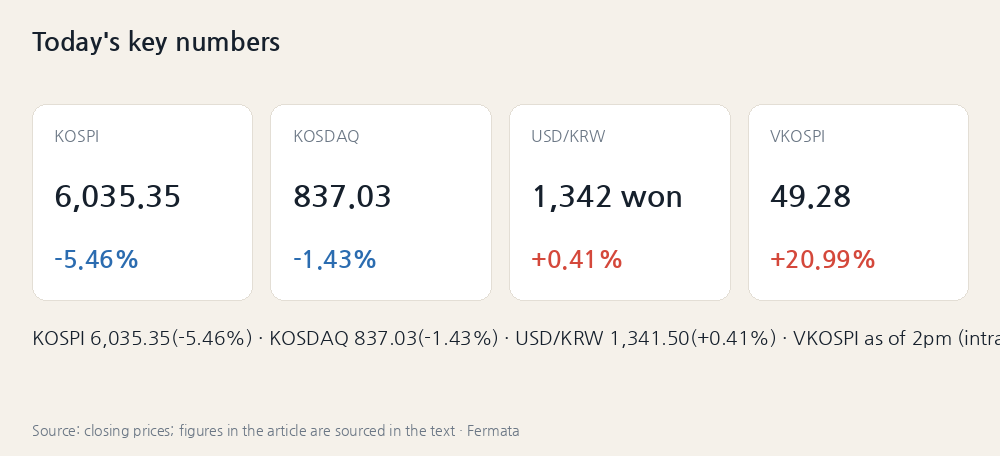
KOSPI fell more than 5% in a single session, its sharpest drop of the year. It briefly broke below the 6,000 mark, touching 5,989.01 intraday, before bargain-hunting in the afternoon pushed it back above 6,000.
VKOSPI, Korea’s fear gauge, jumped 20.99% from the prior session’s 37.94 to 49.28 as of 2pm, and spiked as high as 51.57 intraday (Money Today). A reading above 40 is typically seen as overheated.
Yesterday's check, and how it went
Yesterday’s piece set two conditions to watch by today: whether foreigners would turn net buyers in either Samsung Electronics or SK Hynix, and whether KOSPI would hold the 6,400 level. Both conditions failed.
Foreigners sold a net 4.5319 trillion won across KOSPI, and Samsung Electronics fell 7.39% while SK Hynix fell 10.09%. KOSPI lost not just 6,400 but came close to losing 6,000 as well.
Why KOSPI fell to the 6,000 line
Today’s trigger was China’s CXMT. The Chinese memory maker said it plans to launch server-grade DRAM within the year, reviving fears of memory oversupply, compounded by weakness in the US Philadelphia Semiconductor Index (Money Today).
Early in the session, mini-KOSPI200 futures plunged more than 5%, triggering a sell-side sidecar — the market’s 50th this year and 26th sell-side sidecar, the first since August 20, 34 trading sessions earlier (Edaily).
For beginners: a sidecar halts program-trading orders for five minutes when KOSPI200 futures move sharply in either direction within a session. It is designed to cushion one-sided swings, not to stop a decline outright.

Samsung Electronics and SK Hynix fell together
Samsung Electronics closed at 232,000 won, down 7.39%, and SK Hynix closed at 1,443,000 won, down 10.09%. Both logged their largest single-day drop of the past eight sessions.
Yesterday (October 12), foreigners sold a net 2,178,086 shares of Samsung Electronics and 618,288 shares of SK Hynix, continuing a selling streak in chip giants even before today’s China news.
On Naver Finance consensus, 36 analysts see Samsung Electronics with 113.5% upside to target, and 38 analysts see SK Hynix with 125.8% upside. This year’s estimated P/E is 5.1x for Samsung and 4.1x for SK Hynix.


Photo: STMicroelectronics (original work) Una tantum (screenshot) / Wikimedia Commons (BY 3.0)
Today's biggest faller was APR
APR closed at 283,000 won, down 19.6% — today’s single largest decline. Brokerages cut their third-quarter operating profit estimates.
Daol Investment & Securities estimated APR’s Q3 operating profit at 187.7 billion won, 5% below consensus of 197.5 billion won, while KB Securities put it 14.1% below. Analysts point to rising logistics costs, sales commissions, and a stronger won squeezing margins even as US and European sales roughly double (Seoul Economic Daily, Money Today).
Daol, Shinhan, Hyundai Motor Securities and Meritz all cut their target prices but kept Buy ratings, pointing to the Q4 holiday shopping season as the next checkpoint.
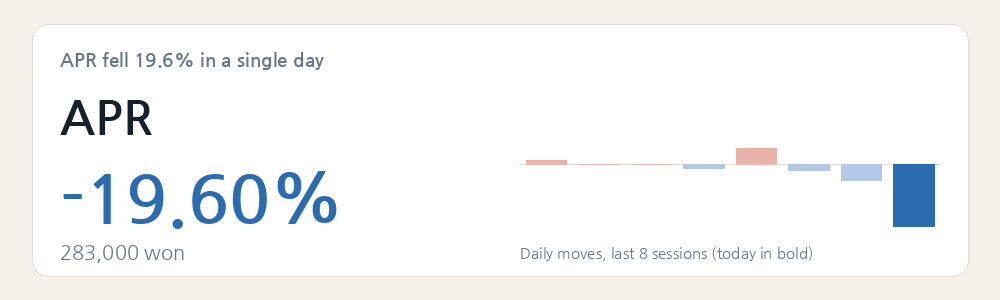

Photo: Vitaly Gariev / Unsplash
It wasn't just chips — whole sectors wobbled
Across the Korea Exchange’s full 79-sector breakdown, semiconductors and semiconductor equipment fell 7.73%, the steepest drop, followed by cosmetics (-7.03%) and electronic equipment (-5.97%). Within semiconductors, 101 of 172 names fell, a clear one-sided move.
Other financials (+2.30%), broadcasting and entertainment (+1.68%) and health care technology (+1.66%) moved the other way. Among the stocks we follow, only the battery group averaged positive, lifted by LG Energy Solution alone — everything else we track fell, underlining how concentrated today’s selling was.

Foreigners sold heavily again today
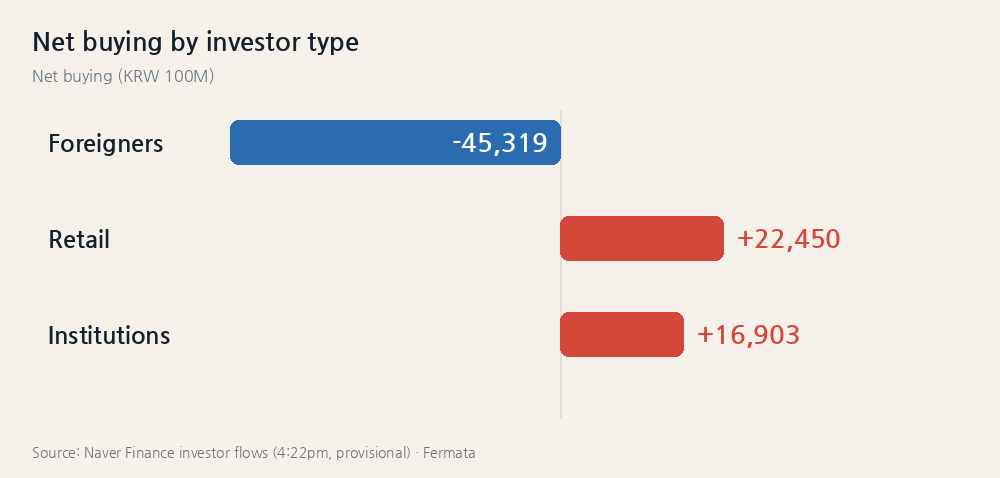
On KOSPI, foreigners sold a net 4.5319 trillion won as of 4:22pm (provisional), while retail bought a net 2.2450 trillion won and institutions bought a net 1.6903 trillion won (Naver Finance).
On KOSDAQ, the pattern flipped: foreigners (+137.4 billion won) and institutions (+43.8 billion won) bought, while retail (-191.1 billion won) sold. The two markets pulled in opposite directions today.
Yesterday, foreigners and institutions also split on some names
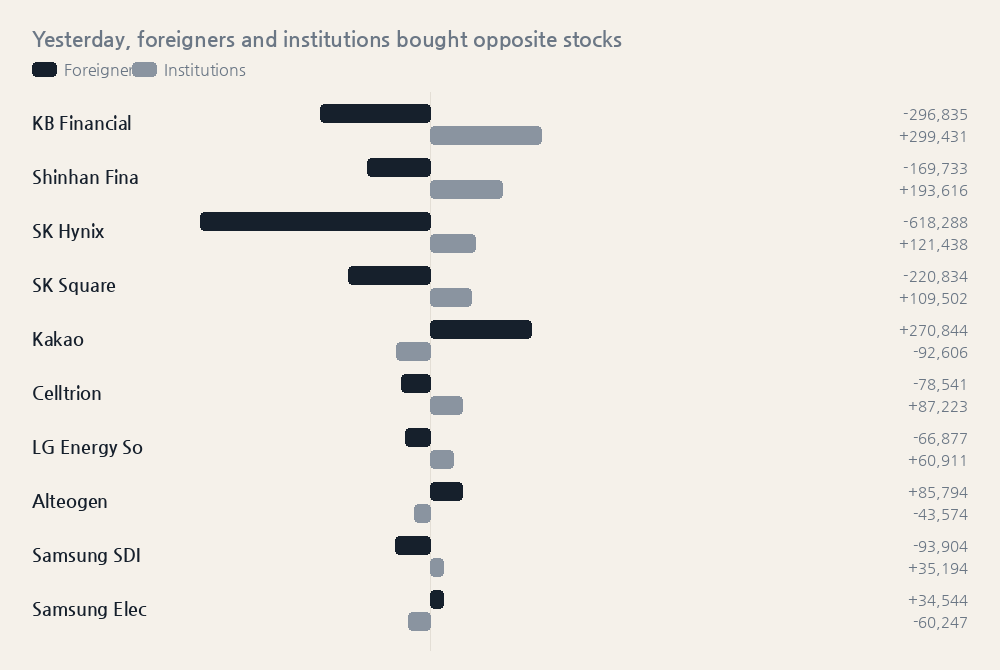
Yesterday (October 12), foreigners bought a net 270,844 shares of Kakao while institutions sold 92,606 shares. SK Hynix saw the opposite: foreigners sold 618,288 shares while institutions bought 121,438 shares.
Even within the same semiconductor sector, foreign and institutional judgment diverged — and on a day like today, when foreign selling intensifies, that divergence feeds straight into volatility.
KOSDAQ and the won moved less
KOSDAQ closed at 837.03, down 1.43% — a smaller drop than KOSPI’s. Unlike chip-heavy KOSPI, foreigners turned net buyers on KOSDAQ today.
The won, quoted at Hana Bank’s reference rate, rose 0.41% to 1,341.50 per dollar. For a day with such a sharp stock selloff, the currency move was modest.
Valuations got cheaper, but opinions differ
Today’s drop made Samsung Electronics and SK Hynix valuations even cheaper. KB Securities called the selloff a multiple contraction rather than an earnings problem, and flagged the 5,600-to-low-6,000s KOSPI range as a buying zone, while citing uncertainty around the US CPI release on October 14-15 as a swing factor. Samsung Securities recommended phasing in rather than buying aggressively (Money Today).
At the same time, Samsung Electronics and SK Hynix drove much of KOSPI’s gains in the first half of the year, so when the two names wobble together, the index wobbles with them.
Today's biggest movers — only two of them gainers
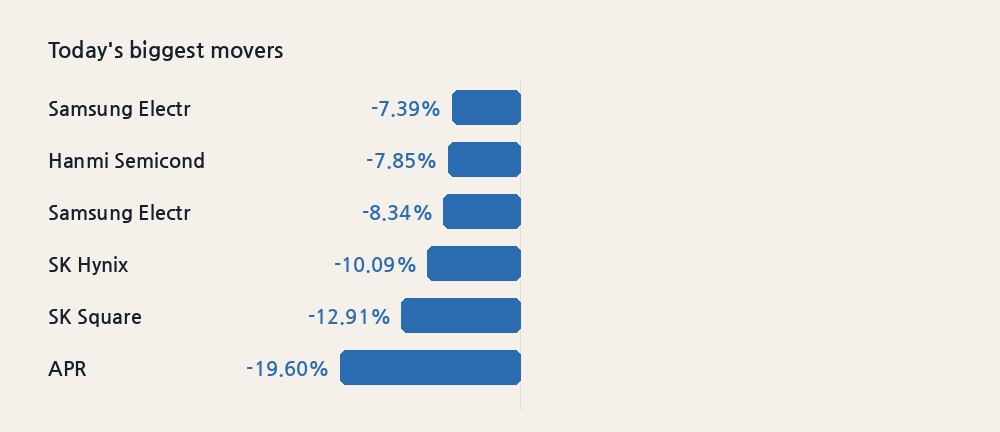
Today’s biggest movers were APR (-19.6%), SK Square (-12.91%), SK Hynix (-10.09%), Samsung Electro-Mechanics (-8.34%), Hanmi Semiconductor (-7.85%) and Samsung Electronics (-7.39%). All of them fell.
While most names fell, Jusung Engineering rose 3.56% and LG Energy Solution rose 3.02% — today’s only two gainers, each diverging from its own sector’s broader decline.
What to watch before the next session
The swing factor for the next session (October 14) is the US CPI release. A hotter-than-expected print could push the 10-year Treasury yield higher and pressure high-multiple sectors like semiconductors further, while a soft print would likely let today’s biggest decliners, Samsung Electronics and SK Hynix, lead any rebound. Whether KOSPI holds the 6,000 line again is also worth watching.
China's DRAM announcement set off the day
A sell-side sidecar hit KOSPI for the 26th time this year
A sell-side sidecar on KOSPI halts program-sell orders for five minutes once mini-KOSPI200 futures fall more than 5% within the session. It triggered early today as futures plunged past that threshold (Edaily).
It was the market’s 50th sidecar this year and the 26th sell-side one, the first since August 20 — a 34-session gap that had suggested volatility was cooling before today.
VKOSPI, Korea’s volatility gauge, spiked to 49.28 as of 2pm, up 20.99% from the prior close of 37.94, and touched as high as 51.57 intraday (Money Today). Readings above 40 are generally read as overheated, and today’s level sits well past that line.
| KOSPI sidecars this year | 50th (26th sell-side) |
| Previous sell-side sidecar | Aug 20, 34 sessions earlier |
| VKOSPI (intraday) | 49.28, +20.99% vs prior close |
CXMT's move revives memory oversupply fears
CXMT, a Chinese memory maker, said it plans to launch server-grade DRAM within the year. For Samsung Electronics and SK Hynix, a new domestic entrant in server memory raises the risk that pricing power — and the AI-cycle margins priced into their valuations — erodes faster than expected (Money Today).
The fear compounds a concentration risk already flagged by the Bank of Korea, which found Samsung Electronics and SK Hynix accounted for roughly 77% of KOSPI’s gain between January and June. When the two names move together, so does the index.
Brokerages are split on what this means. KB Securities and Samsung Securities both read today’s move as a buying opportunity built on cheaper multiples rather than a profit problem. A lower P/E can mean either ‘it’s cheap now’ or ‘the market expects earnings to come down’ — and today’s news pushed more investors toward the second reading, at least for a day.
| Trigger | China's CXMT plans server-grade DRAM this year |
| Also weak | US Philadelphia Semiconductor Index |
| Local chip sector | -7.73% (101 of 172 names fell) |
Fermata’s Take
We set yesterday’s check as whether foreigners would turn net buyers in either Samsung Electronics or SK Hynix, and whether KOSPI would hold 6,400. Both failed today — foreign selling grew to 4.5319 trillion won, and KOSPI came under threat of losing not just 6,400 but 6,000.
Today’s drop wasn’t about earnings; it was China’s CXMT-driven supply fears layered on top of multiple contraction. On Naver Finance consensus, Samsung Electronics and SK Hynix still have more than 100% upside to target, but that gap hasn’t narrowed as foreigners kept selling. So we’re not buying in just because it looks cheap.
The check is tomorrow’s (October 14) US CPI print and KOSPI’s reaction to it. If CPI comes in soft and KOSPI holds above 6,000, we’ll look again at adding on weakness. If CPI runs hot and chips fall further, we hold off adding to semiconductor exposure.
Check · 2026-10-14 — Whether the US CPI print and KOSPI's reaction keep it above 6,000, and whether foreign net selling shrinks from today's 4.5319 trillion won.
Drafted with AI assistance and reviewed by KimHui.