![Korea Market Close data snapshot for 2026-10-01: KOSPI 6,971.35 (+1.95%), KOSDAQ 894.29 (+4.48%), USD/KRW 1,361.6 (+0.27%), biggest moves we track Daeduck Electronics (+12.75%), Jeju Semiconductor (+12.64%), Wonik IPS (+9.13%) [en].](https://fermata.it.kr/wp-content/uploads/2026/10/kr_2026-10-01_editorial_en-da59cecdaf18.png)
Foreigners Sold Again, But We're Still Watching Semiconductors
Today's Mood
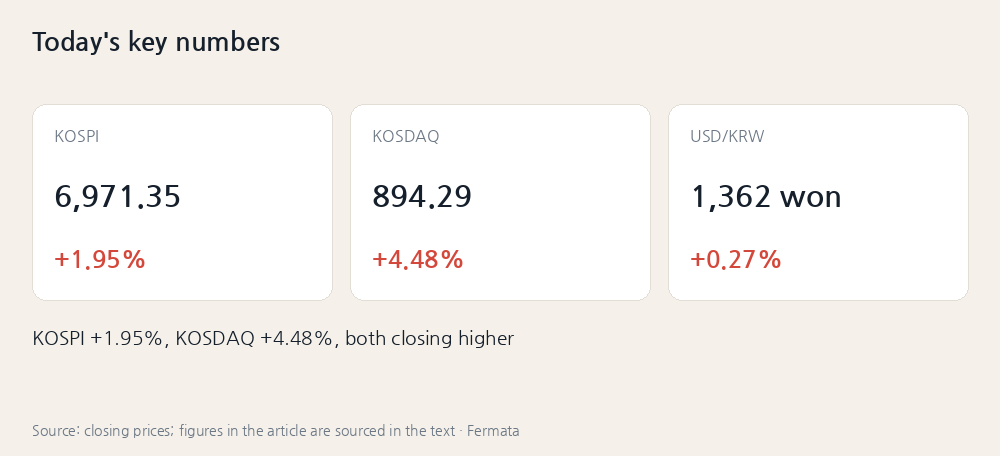
KOSPI and KOSDAQ rallied together on a day that belonged to semiconductors. Buying rushed into chip-related names right from the open, and KOSDAQ in particular stayed strong all session, producing several double-digit gainers.
Micron’s blowout earnings overnight and September export data released this morning pointed the same way — memory-chip demand is now showing up in hard numbers. KOSPI snapped a three-day losing streak on the news, and KOSDAQ moved even more sharply.
Yesterday's Check, Today's Result
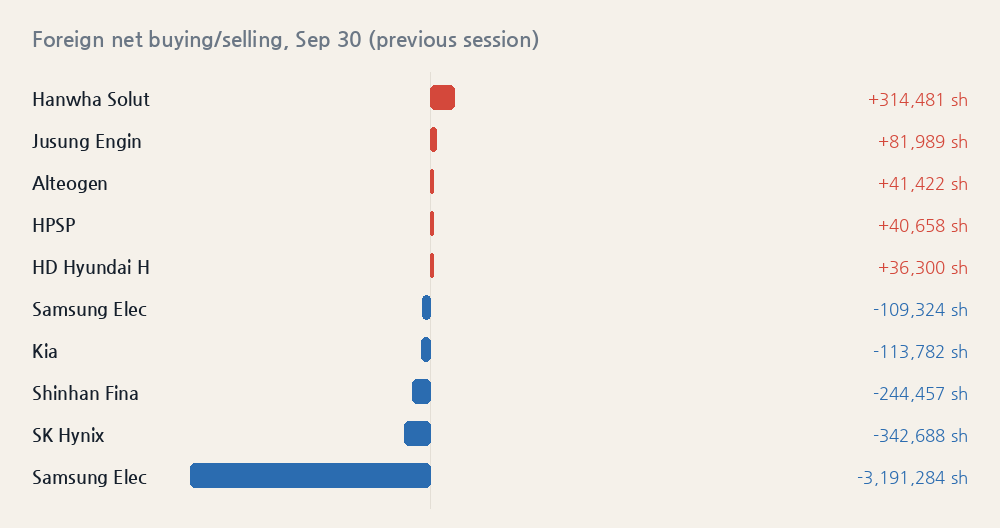
Yesterday’s piece left two things to check by the next session: whether foreign flows turned net buyers after Micron’s earnings and the US PCE print, and how the performance gap between Samsung Electronics and SK Hynix would move.
Foreigners sold another 548.5 billion won on KOSPI today, a fourth straight day of net selling — though well down from the 3.24 trillion won they sold three days ago. The performance gap moved the other way: yesterday the two stocks diverged by more than 2 points, with only SK Hynix in the green, but today both rose together — Samsung Electronics +2.79%, SK Hynix +3.21% — narrowing the gap to about 0.4 points. The return to foreign net buying still hasn’t shown up, but both stocks moving the same direction looks like a shared read on improving memory conditions.
KOSDAQ Rose Twice as Fast as KOSPI
KOSPI gained 1.95% while KOSDAQ gained 4.48% — more than double. In the KOSDAQ market, foreigners bought a net 227.8 billion won and institutions bought 568.2 billion won, while individuals sold 776.1 billion won (Asia Economy) — unlike KOSPI, foreigners and institutions were on the same side today.
The difference comes down to composition. KOSDAQ carries more small- and mid-cap chip-equipment and -parts makers than KOSPI, so it moves harder whenever memory-sector optimism spreads. Today was a clean example of that structure at work.

Micron's Earnings Lit the Fuse
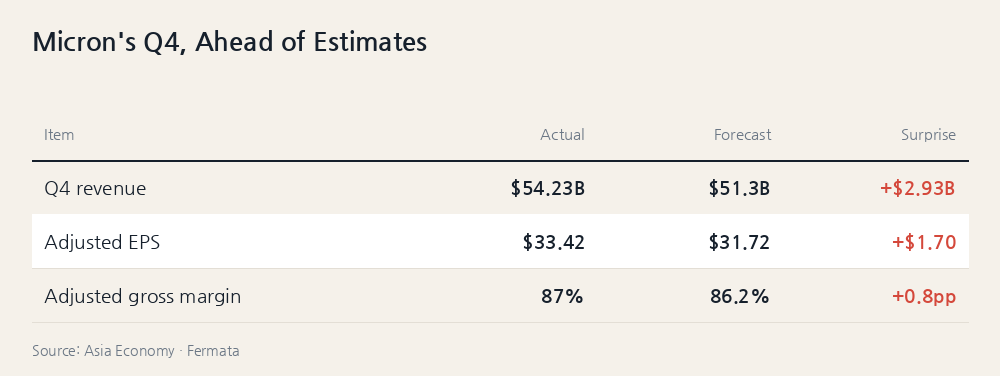
Micron’s fiscal 2026 fourth-quarter results beat expectations. Revenue came in at $54.23 billion versus a roughly $51.3 billion estimate, and adjusted EPS of $33.42 beat the $31.72 estimate. Adjusted gross margin jumped to 87%, up sharply from 45.7% a year earlier (Asia Economy).
Data center revenue was the standout — $18 billion, more than 10 times a year earlier and about 33% of total revenue. That’s high-bandwidth memory (HBM) demand showing up directly in the numbers. Micron also guided next quarter (fiscal Q1 2027) revenue to $61.5 billion, above the roughly $57 billion the market expected.
For beginners: HBM (high-bandwidth memory) stacks multiple layers of DRAM vertically so far more data can move at once. It sits next to the GPU in AI servers, feeding it data fast enough to keep up with the computation — so as AI investment grows, so does HBM demand.
September Exports Were a Chip Story Too
September export data released the same day told the same story. Exports rose 83.5% year over year to a record $120.9 billion, the first time above $120 billion in a single month, with semiconductor exports up 262.8% to a record $60.3 billion (Money Today, Seoul Economic Daily).
More detail is in the insight section below.
Foreigners Sold for a Fourth Day, But Two Stocks Rose
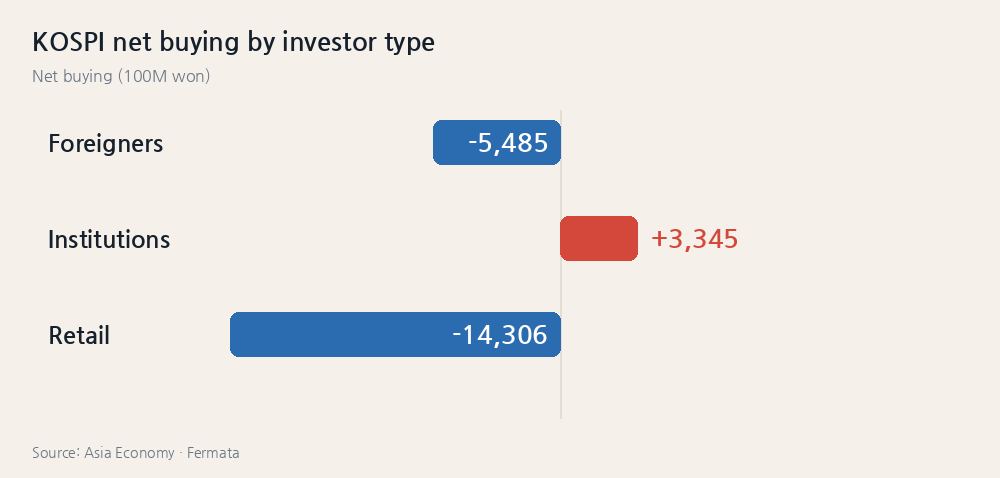
On KOSPI overall, foreigners sold a net 548.5 billion won and individuals sold 1.4306 trillion won today, while institutions alone bought a net 334.5 billion won (Asia Economy). Even so, Samsung Electronics (+2.79%) and SK Hynix (+3.21%) both rose.
That means other buying — institutions, and short-term retail money chasing the chip theme — stepped in on the memory-sector improvement story even as foreigners pulled back from the index as a whole. A split this clear between foreign flows and share-price direction has been rare this year.
Today's Biggest Movers
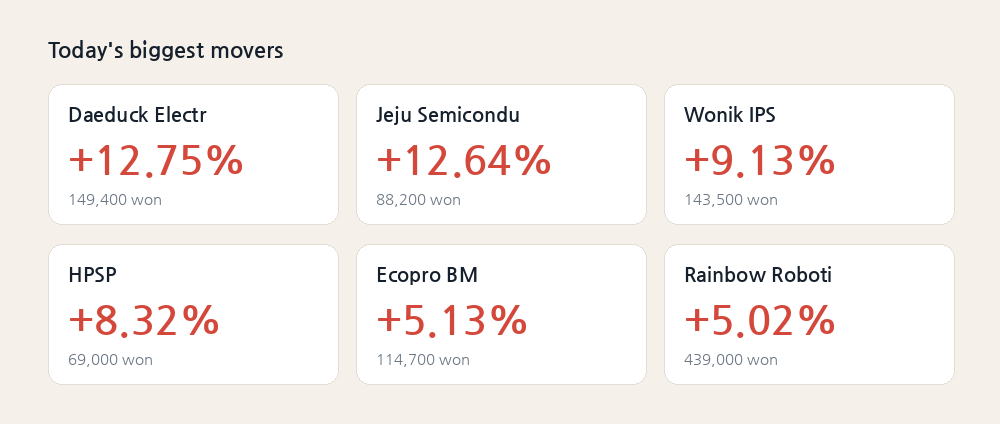
Among the stocks we follow, the biggest gainers today were two names newly added by trading value — Daeduck Electronics (+12.75%) and Jeju Semiconductor (+12.64%). Both are chip-substrate and memory-related names, and the optimism Micron’s earnings generated clearly spread to them. Chip-equipment makers Wonik IPS (+9.13%) and HPSP (+8.32%) also gained high single digits.
Outside chips, battery-materials maker Ecopro BM (+5.13%) and robotics name Rainbow Robotics (+5.02%) also gained more than 5%. Money Today reported that other chip-equipment and -materials names, including Leeno Industrial (+10.9%) and EO Technics (+8.46%), rose 8-10% the same day — buying spread evenly across the sector.
Today's Stock: Daeduck Electronics
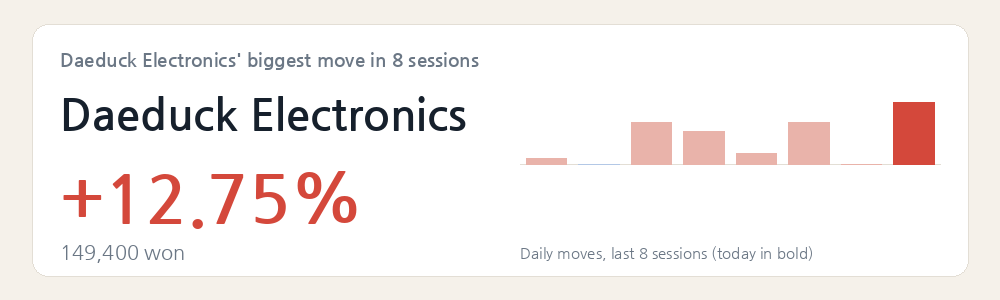
Among the stocks we follow, Daeduck Electronics had the largest move today. Newly added by trading value, it closed up 12.75% at 149,400 won. The chip-substrate maker has long been seen as a prime beneficiary of rising demand for high-end substrates used in servers and AI accelerators, and it has reacted sharply whenever optimism about the memory cycle builds.
Today’s move was the largest single-day swing in its last eight sessions — a sign of how strong buying was across the chip sector today.
Analyst Price Targets Keep Climbing
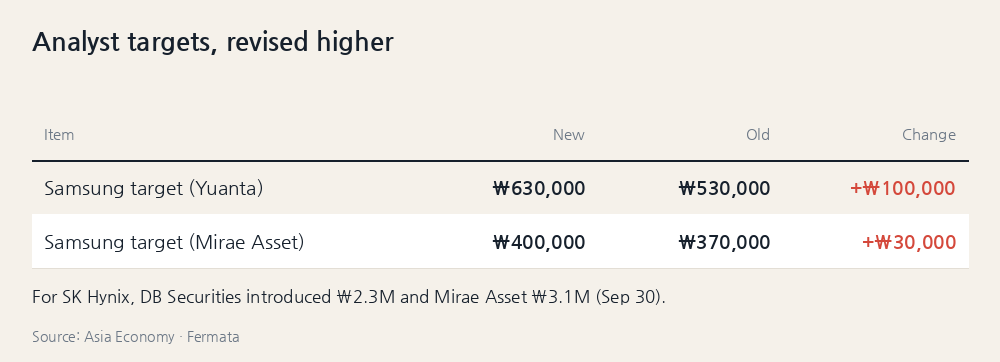
With combined Samsung Electronics and SK Hynix third-quarter operating profit now projected above 188 trillion won, analyst price targets keep rising. Yesterday (Sep 30), Yuanta Securities raised its Samsung Electronics target from 530,000 won to 630,000 won, and Mirae Asset Securities raised its target from 370,000 won to 400,000 won. For SK Hynix, DB Securities introduced a 2.3 million won target and Mirae Asset introduced 3.1 million won (Asia Economy).
The case rests on expected third-quarter DRAM and NAND price increases of 13-18% and 10-15% respectively, and the view that memory supply could stay tight through 2027. Price targets are forecasts, though, not facts.
Banks Fell, Bucking the Trend
On a day chips led the market, bank stocks moved the other way. KB Financial fell 1.66% and Shinhan Financial fell 2.17%. Neither had any specific negative news reported; money likely rotated out as buying concentrated in chips.
Hyundai Motor (+1.16%) and Kia (+0.44%) posted only modest gains, while Hanwha Aerospace (+2.68%) and Samsung Biologics (+2.73%) were the next-best performers after chips.
KOSDAQ Flows and the Won
While foreigners and institutions bought together on KOSDAQ and only individuals sold, the won weakened slightly, with USD/KRW up 0.27% to 1,361.6. The US 10-year Treasury yield climbing back to 5.26%, near the cycle high set on September 29, added to the pressure.
That yield pressure is still there, but today the market reacted far more to improving chip fundamentals.
Micron's Next-Quarter Guidance Faces a Test
No major releases are scheduled before the next session (Oct 2), but how the market digests Micron’s fiscal Q1 2027 revenue guidance ($61.5 billion versus a roughly $57 billion estimate) should help determine whether today’s chip rally has legs.
On the flow side, foreigners extending their KOSPI selling streak to a fourth day remains a live variable. The selling has shrunk but hasn’t flipped to buying yet — we need to see whether that continues into the next session, or turns to buying the way it already has on KOSDAQ.
What We're Watching Today
September Exports Were a Chip Story
According to Korea’s trade ministry, September exports rose 83.5% year over year to $120.9 billion, the first time a single month has topped $120 billion (Seoul Economic Daily, Money Today). Semiconductor exports rose 262.8% to a record $60.3 billion — memory chips rose 358.6% to $54.07 billion and system semiconductors rose 28.8% to $5.54 billion.
Cumulative exports for January-September reached $814.5 billion, already surpassing last year’s full-year record of $709.3 billion with nine months gone (Money Today). The driver is rising memory demand and prices tied to the buildout of AI infrastructure.
The timing matters — this data landed the same day as Micron’s earnings. Two independent signals, a US company’s results and Korea’s trade statistics, point to the same conclusion: memory-chip conditions are improving. We read that overlap as added weight behind today’s chip-equipment rally.
Fermata’s Take
We read today’s joint KOSPI-KOSDAQ surge as being driven by fundamentals — Micron’s strong earnings and September’s 262.8% jump in chip exports — rather than foreign flows. Foreigners sold on KOSPI for a fourth straight day, but the size shrank sharply, from 3.24 trillion won three days ago to 548.5 billion won today, and institutions (+334.5 billion won) filled the gap — the buyer changed, but the money chasing semiconductors didn’t shrink.
So we’re not trimming our semiconductor exposure even with foreign selling still going on. That call is conditional, though — we’ll only treat today’s rally as a trend once Micron’s $61.5 billion guidance for next quarter is actually confirmed in results, and once foreigners show signs of turning net buyers on KOSPI too. By the next session (Oct 2), we’ll check both: whether foreigners turn net buyers on KOSPI, and whether the chip-equipment rally holds up.
Check · 2026-10-02 — Whether foreign investors turn net buyers on KOSPI too, and whether the chip-equipment rally holds up in line with Micron's $61.5 billion guidance for fiscal Q1 2027.