![Korea Market Close data snapshot for 2026-09-30: KOSPI 6,838.04 (-0.48%), KOSDAQ 855.91 (+0.72%), USD/KRW 1,352.0 (-0.11%), biggest moves we track Jusung Engineering (+4.73%), HPSP (+4.43%), Hanwha Solutions (+4.31%) [en].](https://fermata.it.kr/wp-content/uploads/2026/09/kr_2026-09-30_editorial_en-a680c27663ff.png)
One Day Before Micron Earnings, Here's the Number to Watch Tomorrow Morning
Today's Mood
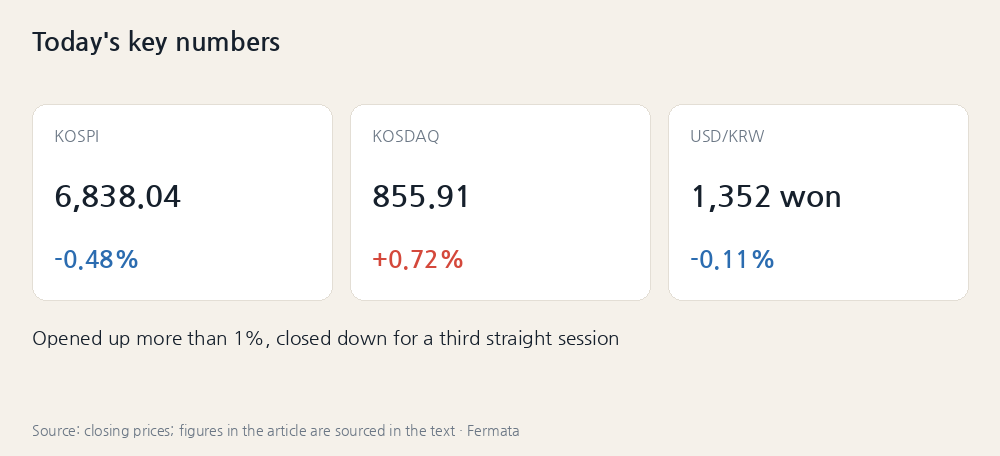
KOSPI opened more than 1% higher and climbed as far as the 6,940 level, then gave up the entire gain in the afternoon as foreigners and institutions sold in tandem. It was the index’s third straight decline since the Chuseok holiday.
Tonight in the US, Micron — widely watched as a bellwether for the memory-chip cycle — reports earnings alongside the US personal consumption expenditures (PCE) inflation reading. Today’s split session, with equipment makers rallying while large-cap chipmakers stayed cautious, looked like the market waiting on that result.
Yesterday's Check, Today's Result
In our September 23 piece, we said we’d check two things by the next session on the 28th: whether foreign investors turned net buyers again, and how any chip- or tariff-related language from the US-China summit showed up in large-cap chipmakers Samsung Electronics and SK Hynix.
The result went the other way. The September 24 summit only extended the tariff truce by two months, and the US Trade Representative made clear that advanced chip export controls were not on the table. KOSPI fell 191.18 points (2.70%) on the 28th as that news was digested, with Samsung Electronics and SK Hynix both dropping more than 5%. Foreigners kept selling for three straight sessions — 3.24 trillion won on the 28th, roughly 2.9 trillion won on the 29th, and 2.0568 trillion won today. Neither the return to foreign buying nor a joint rebound in the large-cap chipmakers materialized.
KOSPI Fell for a Third Straight Session
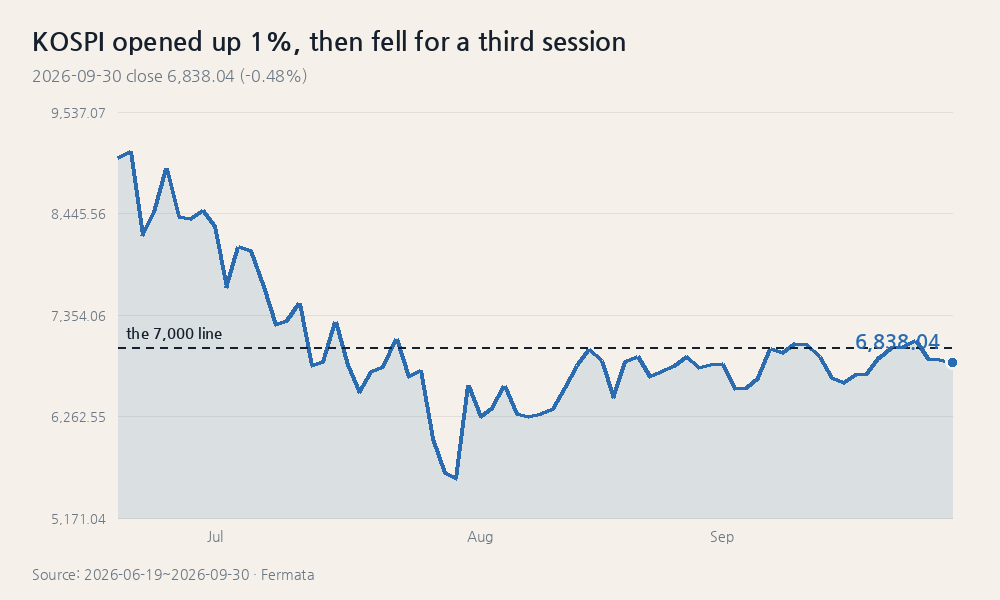
KOSPI closed down 32.77 points (0.48%) at 6,838.04. It opened at 6,943.47 (+1.06%) as chip-related names rallied on news that OpenAI had unveiled an always-on AI agent, but the gain started shrinking by mid-morning after topping out near 6,940.
In the afternoon, pressure from rising US Treasury yields combined with caution ahead of Micron’s earnings to erase the entire advance and flip the index negative. Reclaiming the 7,000 line was pushed off once again.
The Summit Didn't Touch Chip Export Controls
At the September 24 summit, President Trump and President Xi agreed to extend the tariff-war truce by two months, to January 10 next year — shorter than the three-to-six months markets had expected.
The standoff over chip export controls didn’t narrow. The US Trade Representative said advanced semiconductor export controls were not up for negotiation, and both sides held their existing positions on Taiwan as well. A summit that ended without a clear breakthrough is what markets sold into when trading resumed on the 28th — the starting point of this three-day slide.
US Treasury Yield Pressure Kept Building
The US 10-year Treasury yield climbed from 4.48% to 5.24% over the past 90 days, a 90-day high. On the 29th, the 30-year yield rose to 5.609%, its highest level since 2002.
Barclays Capital strategist Anshul Pradhan argued the Treasury sell-off hasn’t yet priced in the risk to sustained productivity growth, leaving room for the 30-year yield to reach 6%. In a Bloomberg survey of 173 market professionals, 53% expected the 30-year yield to top 6% before year-end.

Chip Equipment Makers Rallied Instead
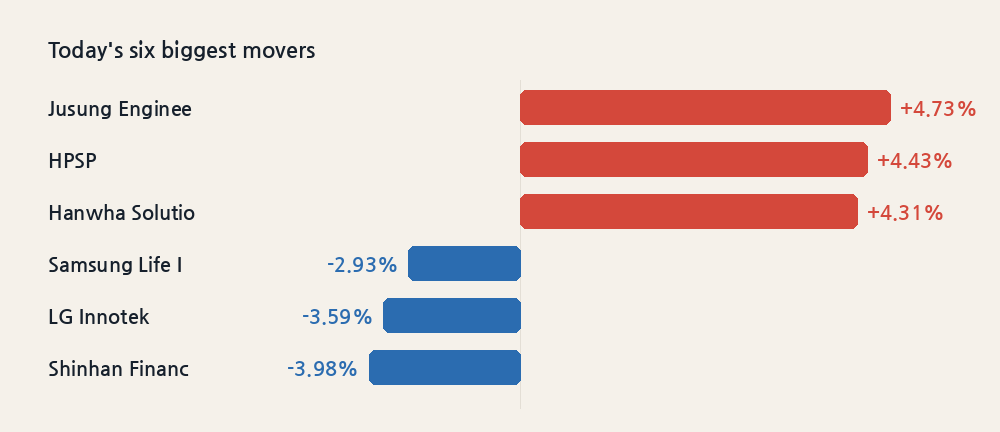
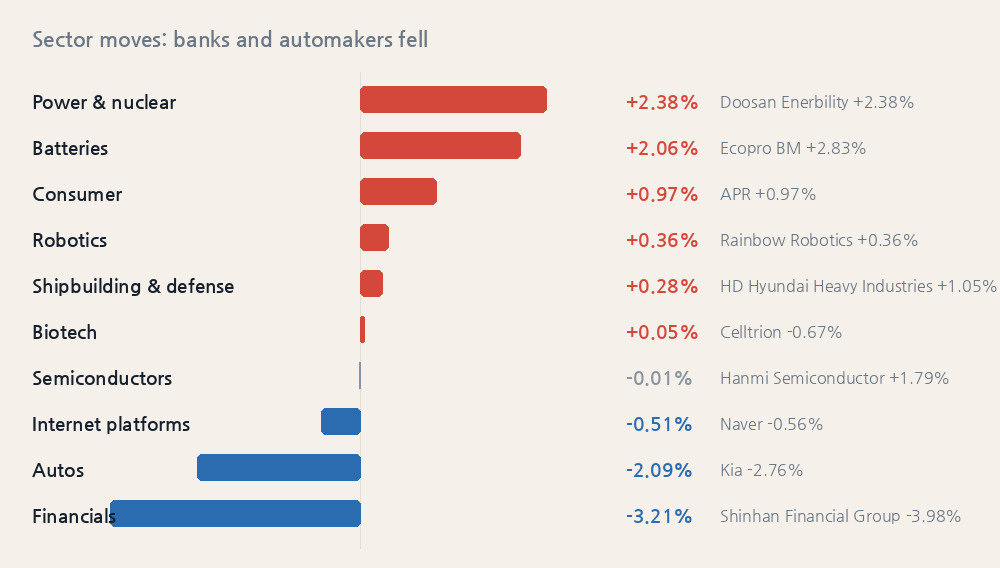
Chip equipment names rose even as Treasury yields weighed on the broader market. Jusung Engineering climbed 4.73% to close at 232,500 won, pushing its market cap to third place on KOSDAQ (about 10.66 trillion won), and HPSP rose 4.43%. The move followed renewed optimism over AI infrastructure spending and chip demand after OpenAI unveiled its always-on AI agent.
Among the core names, Hanmi Semiconductor rose 1.79% on the same theme. But in the same broader chip-parts group, LG Innotek fell 3.59% and HD Hyundai Electric fell 2.79% — no disclosure or news explaining either decline could be confirmed today.
Hanwha Solutions Rose on a Higher Target Price
Hanwha Solutions rose 4.31% to close at 33,900 won. Samsung Securities raised its 12-month forward EBITDA estimate for the company by 5% and lifted the multiple it applies to renewable-energy peers from 13.5x to 14.8x, setting a new target price of 41,000 won — 24.2% above its prior target. The logic: US policy support for domestic solar manufacturing investment should help the profitability of Hanwha Solutions’ wafer, cell, and module businesses.
Today’s closing price is still 21% below the new target.
Samsung and SK Hynix Still Trade Cheap
Samsung Electronics fell 1.47% to 268,500 won while SK Hynix rose 0.62% to 1,776,000 won — a split within the same large-cap chip pair. On valuation alone, both still look cheap: on next-12-month expected earnings, Samsung Electronics trades at a forward P/E of 3.8x and SK Hynix at 3.8x, 78.3% and 76.9% below their respective analyst target prices (story_engines valuation engine, Yahoo Finance consensus).
Beginner’s note: forward P/E shows how many times next year’s expected earnings the current stock price represents. The lower this number, and the wider the gap to the target price, the bigger the difference between where analysts see fair value and where the stock trades today.
New material also emerged that could close that gap. Samsung Electronics and five other Samsung affiliates said they would invest a combined $1 billion (Samsung Electronics’ share: $500 million) in US AI infrastructure firm Helix. KB Securities called it a direct entry at the very top of AI data-center demand, noting that DRAM average selling prices are expected to rise 15-20% quarter-on-quarter in both Q3 and Q4, with the top three global DRAM makers’ capacity effectively sold out through 2028 — reasons, in KB’s view, to re-rate the strategic value of Samsung’s memory business.
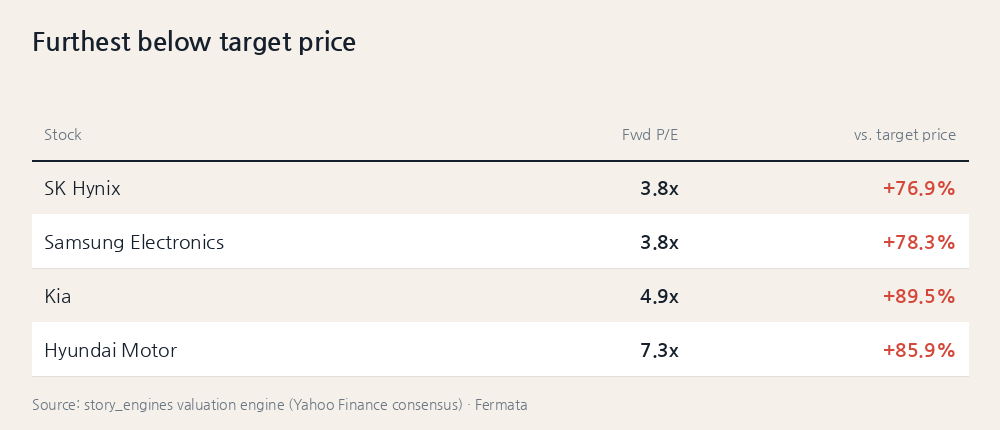

Photo: naotakem / Flickr (BY 2.0)
Banks and Automakers Fell Together
Banks and insurers also weakened on rising rates and risk aversion. Shinhan Financial fell 3.98%, KB Financial fell 2.71%, and Samsung Life fell 2.93%. Automakers slid too, with Kia down 2.76% and Hyundai Motor down 1.43%. Battery bellwether LG Energy Solution was the exception, rising 1.28%.
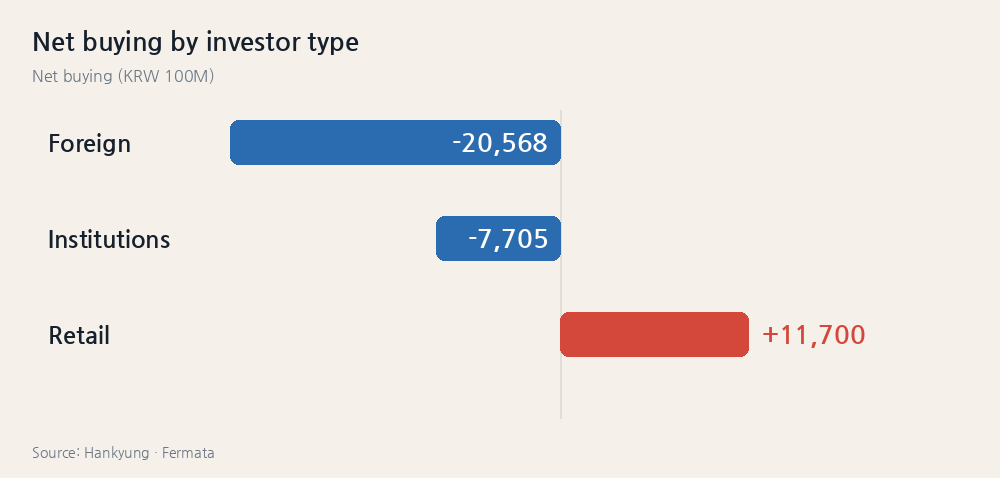
Retail Was the Only Buyer Today
Today’s investor flows were foreign net selling of 2.0568 trillion won, institutional net selling of 770.5 billion won, and retail net buying of 1.17 trillion won. Retail’s buying was its largest in three sessions, but it wasn’t enough to absorb what foreigners and institutions were selling.
KOSDAQ and the Won
KOSDAQ moved opposite KOSPI, rising 6.11 points (0.72%) to close at 855.91 as chip equipment strength lifted the index. The won firmed slightly, with the dollar easing 0.11% to 1,352.0 won.
Micron and PCE Will Set the Next Direction
Before the next session on October 1, the US will report Micron’s earnings and then the PCE inflation gauge. Since Micron is read as a bellwether for the DRAM cycle, markets will look to its results to confirm — or undercut — the memory re-rating case now building around Samsung Electronics and SK Hynix.
A supply-demand variable is also approaching. As of September 20, Samsung Electronics had completed 74.69% of its buyback and SK Hynix 58.79%, putting their expected completion at six-to-seven and fifteen-to-sixteen trading days away, respectively. Six trading sessions have passed since then, so Samsung Electronics’ buyback in particular is likely nearing its end. With foreigners selling for a third straight day, losing that buying support too could expose a real demand gap.
What We're Watching Today
When Do the Samsung and SK Hynix Buybacks End
Samsung Electronics’ and SK Hynix’s share buybacks have been one of the market’s biggest sources of support this year. As of September 20, Samsung Electronics had bought back 39.8 million of its planned 53.285968 million shares (74.69%), and SK Hynix had bought 14.15 million of its planned 24.07 million shares (58.79%).
At their average daily pace (roughly 2 million shares for Samsung Electronics, 650,000 for SK Hynix), the buybacks were projected to finish in six-to-seven and fifteen-to-sixteen trading days, respectively — about a month earlier than originally scheduled for November. Six more trading sessions have passed since that snapshot, so Samsung Electronics’ buyback in particular is likely near its final stretch by now.
With foreigners on a three-session selling streak, losing this buying support right as it ends could show up directly in price. We’re treating the moment this buyback actually winds down as our next thing to check.
| Samsung Electronics buyback progress (as of 9/20) | 74.69% |
| SK Hynix buyback progress (as of 9/20) | 58.79% |
| Samsung Electronics cumulative buyback | 10.3078 trillion won |
| SK Hynix cumulative buyback | 24.39 trillion won |
Fermata’s Take
We read today’s session — KOSPI opening up more than 1% and still closing lower for a third straight day — as caution ahead of Micron’s earnings and the PCE print outweighing the AI-infrastructure optimism sparked by OpenAI’s news. The heavier signal is the flow data: foreigners have now sold for three straight sessions since the US-China summit — 3.24 trillion won on the 28th, roughly 2.9 trillion on the 29th, and 2.0568 trillion won today — and the return to net buying we flagged in our September 23 piece still hasn’t shown up. Still, SK Hynix (+0.62%) holding up better than Samsung Electronics (-1.47%) within the same chip pair looks to us like an early sign of the memory re-rating case triggered by the Helix investment.
So we’re not adding to Samsung Electronics or SK Hynix at today’s prices until we can confirm their buybacks have actually wound down — if that buying support disappears while foreign selling continues, the resulting gap could show up directly in price. Instead, we’ll check next whether foreign flows turn to net buying once Micron’s earnings and the PCE print are out, and how the performance gap between Samsung Electronics and SK Hynix moves from here.
Check · 2026-10-01 — Whether foreign investors turn net buyers again once Micron's earnings and the US PCE inflation reading are out, and how the performance gap between Samsung Electronics and SK Hynix moves.