![Korea Market Close data snapshot for 2026-09-14: KOSPI 6,684.37 (-3.26%), KOSDAQ 806.79 (-1.69%), USD/KRW 1,345.4 (+0.12%), biggest moves we track SK Square (-8.08%), SK Hynix (-6.62%), SK Innovation (-6.28%) [en].](https://fermata.it.kr/wp-content/uploads/2026/09/kr_2026-09-14_editorial_en-5df8f1a4de50.png)
Down 3.26% in a Day, How Much Further Can KOSPI Fall?
Today's mood
KOSPI rebounded three sessions ago from an oil-and-rates shock, only to buckle again a day later. Today the same pressures didn’t ease — a new one piled on top of them, and the drop was bigger than before.
The index widened its losses from the opening bell and never found a foothold through the afternoon. KOSDAQ fell too, but only about half as much as KOSPI.

Yesterday's checkpoint, checked today
Yesterday’s brief said we’d check three things this session — where Treasury yields went after the U.S. August CPI, whether Brent held above $100, and whether foreign and institutional selling eased.
Two of the three got worse. Core CPI rose 0.3%, above the 0.2% forecast, and the odds of a September Fed hike jumped from 72.4% to 87.3% in a single day (Etoday). Brent didn’t just hold $100 — it climbed toward $108 after a drone strike knocked out Saudi Arabia’s East-West pipeline and Iran-Gulf talks over Hormuz transit were postponed (Hankyung). Foreign net selling grew from 2.4587 trillion won to 3.2996 trillion won. Institutions sold less than before (1.1716 trillion won versus 1.6443 trillion won), but individuals were still the ones absorbing the selling (Asia Economy).
With two of the three readings clearly worse, yesterday’s ‘short-term shock’ call looks premature today.
KOSPI slipped back under 6,700
KOSPI closed at 6,684.37, down 225.54 points, or 3.26%, from the prior session. It had barely cleared 6,700 at 6,909.91 just three sessions ago and gave that level back again, now more than 5% below the 7,051.64 high it touched earlier this month. KOSDAQ fell 13.85 points, or 1.69%, to 806.79.

Oil, rates and AI — three headwinds hit at once
Today’s decline wasn’t driven by one thing — it was three.
First, oil. Saudi Arabia halted its East-West pipeline after a drone strike, and Iran-Gulf talks over Hormuz Strait transit were postponed, pushing Brent toward $108 a barrel (Hankyung).
Second, rates. Markets increasingly expect both the U.S. Federal Reserve and the Bank of Japan to raise rates by 0.25 percentage points this week (Hankyung).
Third, the AI slowdown narrative. Anthropic’s CEO said the industry needs to ‘pace the frontier,’ and OpenAI’s Sam Altman and Elon Musk echoed similar concerns, reviving worries about AI capex (Hankyung). On top of that, China’s DeepSeek unveiled ‘V4.1 Flash,’ a new model that sharply cuts high-bandwidth memory (HBM) and SSD requirements, casting doubt on memory demand forecasts.
For beginners: HBM (high-bandwidth memory) stacks multiple DRAM chips vertically to sharply boost data processing speed, and it’s a core component in AI server chips. A model that needs less HBM adds uncertainty to the earnings outlook for HBM suppliers like SK Hynix and Samsung Electronics.
Chips fell hardest
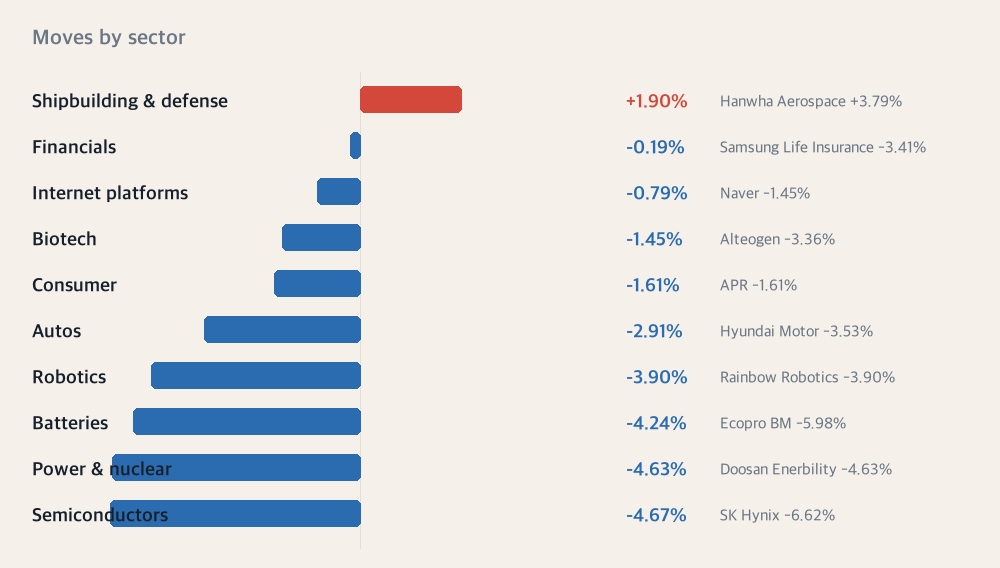
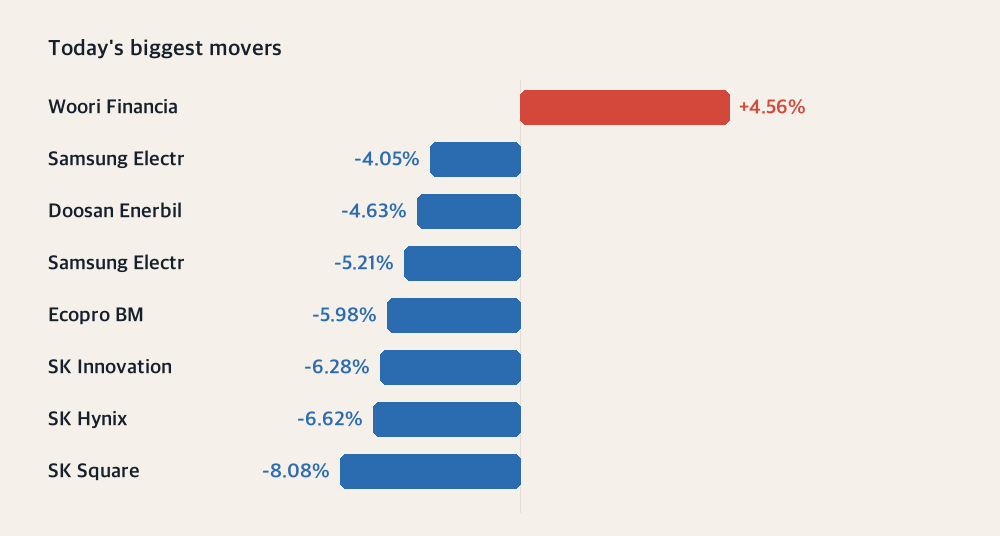
Of the three headwinds, chips took the biggest hit. Samsung Electronics fell 4.05% to 249,000 won, and SK Hynix fell 6.62% to 1,692,000 won. Foreigners sold a net 474.7 billion won in the electronics sector alone (The Fair News).
Samsung Electro-Mechanics slipped 5.21% to 1,327,000 won alongside them. Still, it’s too early to read today’s selling as a reversal of the earnings outlook itself — our tally puts SK Hynix’s 12-month forward P/E at 3.6x, 88% below its average target price. More on valuation below.
Photo: Un ragazzo chiamato Bi / Flickr (BY-SA 2.0)
Today's headline stock: SK Square
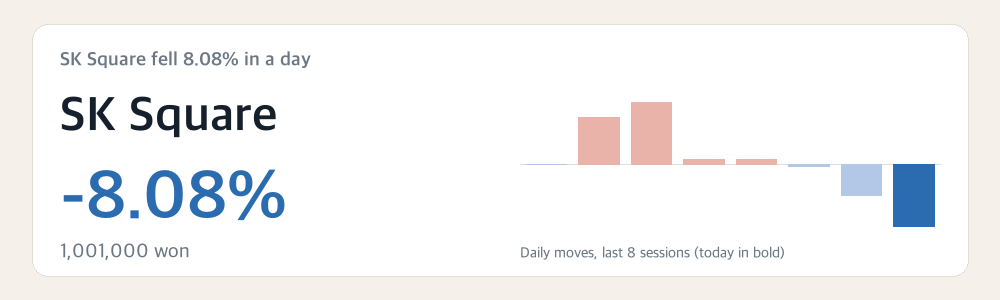
The biggest mover among the stocks we follow today was SK Square, down 8.08% to 1,001,000 won. It’s not an ordinary holding company — it’s an investment holding company priced on the value of its stakes, and most of that value sits in its SK Hynix stake. When SK Hynix falls, SK Square tends to move even more, and that pattern has repeated over the past several sessions.
Trading value came to 505.8 billion won, among the highest on KOSPI today.
SK Innovation and Ecopro BM slipped together
SK group affiliates and battery names fell together. SK Innovation dropped 6.28% to 135,700 won — its battery unit SK On has posted losses in every year since launch, eating into group earnings, and a shareholder meeting over its merger with SK IE Technology added to the volatility (Job Post).
Ecopro BM fell 5.98% to 103,700 won and Samsung SDI fell 2.39% to 532,000 won. Doosan Enerbility dropped 4.63% to 86,600 won, one of the bigger losers in the power and nuclear sector.
Shipbuilding and defense split this time
Within the same shipbuilding-and-defense group, direction diverged today. HD Hyundai Heavy Industries held flat at 479,000 won even as the broader market fell, while Hanwha Aerospace rose 3.79% to 1,122,000 won.
Hanwha Aerospace unveiled a wheeled self-propelled howitzer based on its K9 platform last month, aimed at a U.S. Army modernization program, and hopes for a U.S. market entry have been building (The Fair News).
Banks held up again, insurers didn't
Rising rates were a tailwind for banks again. Woori Financial Group rose 4.56% to 36,700 won, the biggest gainer among today’s stocks, while KB Financial rose 1.52% and Shinhan Financial rose 1.33%.
Higher rates widen banks’ net interest margins, leaving room for interest income to grow. Hana Securities said bank stocks are clearing their August correction and should rebound in September, naming Woori Financial and KB Financial as top picks (Business Post).
But within the same financial sector, insurers didn’t follow. Samsung Life fell 3.41% to 297,000 won, showing the rate tailwind didn’t spread across the whole sector.
Photo: David Trinks / Unsplash
Foreigners and institutions both sold; individuals bought
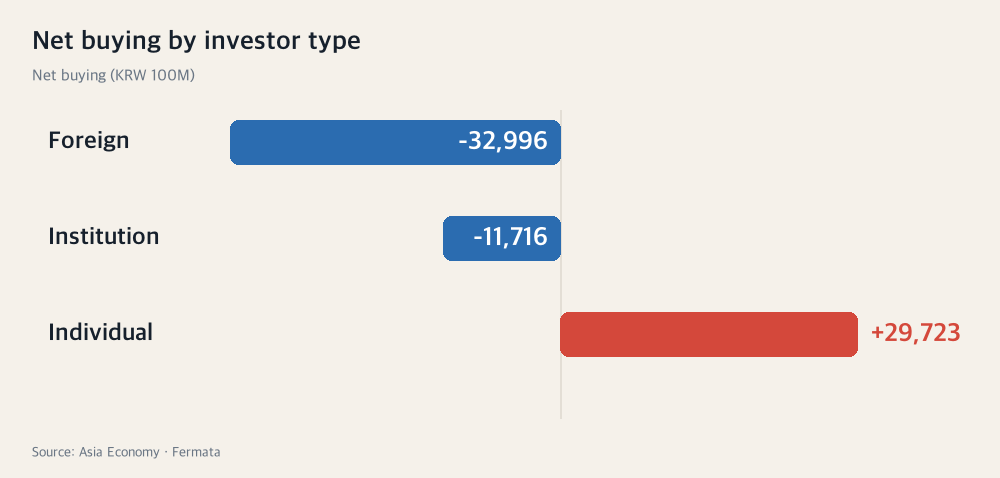
Today’s flows again had foreigners and institutions selling while individuals bought. Foreigners sold a net 3.2996 trillion won and institutions sold 1.1716 trillion won, while individuals bought a net 2.9723 trillion won, cushioning the decline (Asia Economy).
The won
Unlike KOSPI’s sharp fall, the won-dollar rate was fairly calm. Based on Hana Bank’s notice rate, the won-dollar rate rose 1.6 won, or 0.12%, to 1,345.4 won. For a day when domestic stocks swung this hard, the currency reaction was muted.
What to watch next session
First is the Fed’s September FOMC decision, due in the early morning hours of the 17th Korea time. Markets see a 0.25-point hike as the likely outcome (Hankyung). The Bank of Japan is expected to raise rates the same week, and if both land together they could hit Treasury yields and the won at once.
Second is oil and the Middle East. Whether Saudi Arabia’s East-West pipeline comes back online, and whether Iran-Gulf talks over Hormuz transit resume, will decide whether Brent holds in the $108 range.
Third is chip flows. We’ll watch whether foreigners keep selling the electronics sector or start buying back in on valuation.
Last is the DeepSeek-driven HBM demand debate — whether it turns into actual downgrades to Korean chipmakers’ earnings outlooks, or fades as a short-lived scare. We’ll track that through next session’s chip-sector return.
What stood out today
SK Hynix's valuation is still cheap despite the DeepSeek doubts
It’s too early to read SK Hynix’s 6.62% drop today purely as an earnings worry. DeepSeek’s lower-HBM model did raise real questions about memory demand, but valuation suggests much of that concern was already priced in.
For beginners: P/E (price-to-earnings ratio) divides share price by earnings per share — the lower it is, the cheaper the stock relative to its earnings.
By our tally, SK Hynix trades at a 12-month forward P/E of 3.6x, 88% below the average target price set by 38 analysts, and 43% below its 52-week high. Samsung Electronics is in a similar spot at a 3.5x forward P/E.
That doesn’t mean the targets are right, but selling at valuations this low looks more like a short-term reaction to fresh headwinds — DeepSeek, rates, oil — than a sign the earnings estimates themselves have broken down.
| SK Hynix close today | 1,692,000 won (-6.62%) |
| 12-month forward P/E | 3.6x (-88% vs. target) |
| vs. 52-week high | -43% |
| Samsung Electronics forward P/E | 3.5x (-91% vs. target) |
The pension fund bought Daedeok Electronics fourteen times this week
Here’s something price data alone wouldn’t show. Korea’s National Pension Service bought shares of Daedeok Electronics on the open market fourteen separate times over the past seven days, adding up to more than 40.8 billion won (Financial Supervisory Service disclosures).
Purchase prices ranged widely, from 94,141 won to 154,542 won, which looks like several days of buying disclosed together rather than a single day’s trade. Daedeok Electronics isn’t one of our core or dynamically-added names, so this purchase is something price data alone couldn’t have surfaced.
Open-market buying by a pension fund is different from inheritance transfers or stock-option exercises — it’s paid for with the fund’s own money, which makes it a genuine signal of buying conviction.
| Disclosed purchases | 14 (open market) |
| Total purchase value | roughly 40.8 billion won |
| Purchase price range | 94,141 – 154,542 won |
Fermata’s Take
We don’t read today’s 3.26% KOSPI decline the way we read yesterday’s — as a short-term shock alone.
Yesterday we judged that the oil-and-rates shock split sectors without damaging earnings. Today that call looks premature. Foreign selling grew rather than eased, oil didn’t just hold $100 but climbed to $108, and DeepSeek’s lower-spec AI model added a genuinely new question mark over HBM demand. Chips falling far more (Samsung Electronics -4.05%, SK Hynix -6.62%) than banks and defense rose is also a reason to read this less as sector rotation and more as chip-specific weakness this time.
Still, SK Hynix trading at a 12-month forward P/E of 3.6x, 88% below its target price, is a sign this selloff hasn’t yet come from collapsing earnings estimates. Next session, we’ll check the Fed FOMC outcome, whether Brent holds in the $108 range, and whether foreign chip selling eases, alongside KOSPI’s own move.
Check · 2026-09-17 — Where rates head after the Fed's September FOMC decision (early morning of the 17th Korea time), whether Brent climbs further past $108, and whether foreign net selling in chips eases, checked against next session's KOSPI and chip-sector returns.
Sources
- Asia Economy Korean-language article
- Money Today Korean-language article
- Korea Economic Daily Korean-language article
- Edaily Korean-language article
- thefairnews.co.kr Korean-language article
- job-post.co.kr Korean-language article
- Etoday Korean-language article