KOSPI vs KOSDAQ 2026: The Year-End Target Nobody Actually Sets
KOSPI vs KOSDAQ, and why the 2026 target you found isn't KOSPI 200
KOSPI and KOSDAQ are Korea’s two separate stock exchanges — KOSPI lists the country’s large, established companies, and KOSDAQ lists smaller, growth-oriented ones. If that board-to-board comparison is what you’re after, our companion guide, KOSPI vs KOSDAQ: Korea’s Two Boards, Explained, covers it directly. This guide answers a narrower version of the same question: KOSPI vs KOSDAQ when you’re hunting for a 2026 year-end target, where each market actually carries two different numbers, not one.
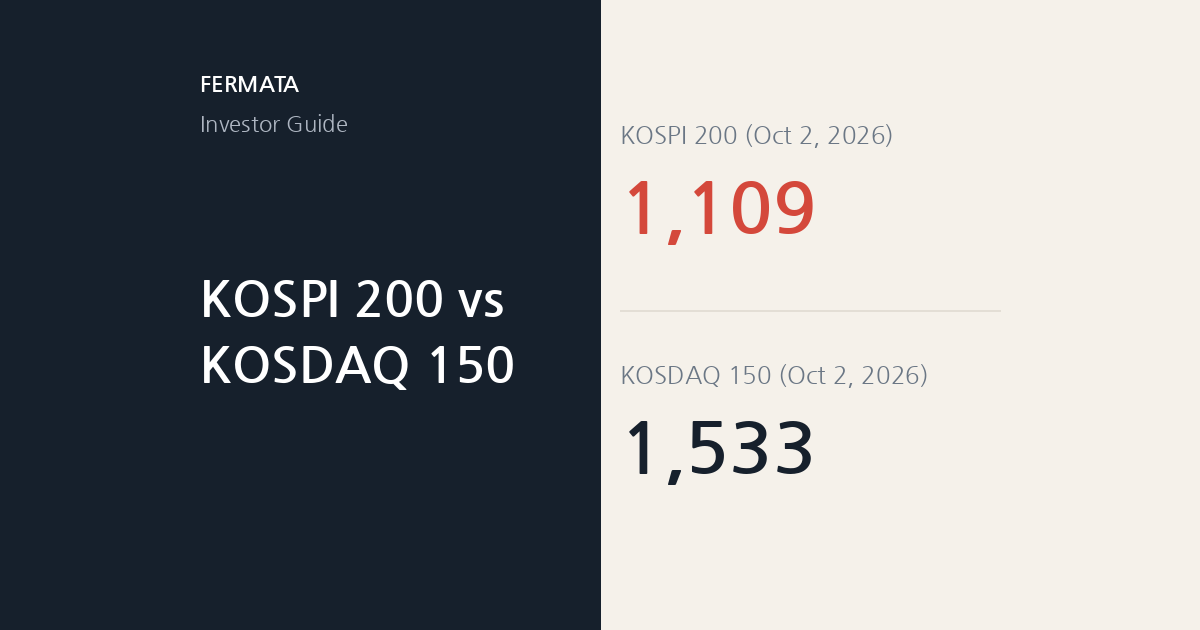
If you searched for a KOSPI 200 or KOSDAQ 150 year-end target for 2026, the numbers you’ll actually find in Korean financial media — 6,500, 10,500, 11,500 — are not KOSPI 200 or KOSDAQ 150 figures at all. They are targets for the KOSPI Composite Index, the broad, all-common-stock benchmark that Korea Exchange (KRX) headlines quote every trading day, currently trading around 7,000. KOSPI 200 is a separate, smaller number: a curated 200-stock subset of the same board, built by Korea Exchange for futures, options and index funds, and it closed at 1,109.05 on October 2, 2026 — a completely different scale from the Composite it is drawn from.
KOSDAQ works the same way. “The KOSDAQ” in a headline means the KOSDAQ Composite, which closed at 893.29 on October 2, 2026. KOSDAQ 150 is Korea Exchange’s curated large-cap subset of that board, the one KOSDAQ 150 futures and ETFs like KODEX KOSDAQ150 actually track, and it traded around 1,533 on October 2, 2026. None of the brokerage forecasts below are built around either 200-stock or 150-stock index level — they are Composite calls, and this guide is upfront about that gap before walking through what strategists actually said.
Why nobody publishes a standalone KOSPI 200 or KOSDAQ 150 target
This isn’t an oversight. KOSPI 200 and KOSDAQ 150 exist to be tracked by financial products — Korea Exchange rebalances KOSPI 200 twice a year using an industry-group method, and KODEX 200, TIGER 200 and the KOSPI 200 futures and options market are all built on it — not to be forecast as standalone headline numbers the way the Composite is. When a Korean brokerage does put a number on the companies inside KOSPI 200, it is usually an earnings estimate, not an index level: Samsung Securities, for instance, estimated 2026 operating profit for KOSPI 200 constituents at roughly 384 trillion won, up about 37% year over year, driven by what the firm called the strongest earnings momentum in the world at the time.
That earnings number is the input strategists actually use to build their Composite-level price targets — a rising profit estimate for the same 200 large-cap companies pushes the Composite target up, even though the KOSPI 200 index figure itself is never the headline. If you want a number that moves with sentiment toward Korea’s biggest companies, watch the profit estimates for KOSPI 200 firms; if you want the number the media quotes, that’s the Composite, covered next.
How fast 2026 KOSPI Composite targets actually moved
The 2026 targets did not sit still. Korea Investment & Securities opened the year by raising its KOSPI target from 4,600 to 5,650 on January 7, citing a 12-month forward EPS estimate of 435 — 28.8% above its October 2025 forecast — at a target price-to-earnings ratio of 13x. Seven weeks later, on February 27, Morgan Stanley raised its base-case target from 5,200 to 6,500 and its bull case from 6,000 to 7,500, while JPMorgan separately put a bull-case figure of 7,500 on the table the same week, both citing an AI-linked memory semiconductor supercycle.
The index kept outrunning even those upgrades. On May 14, KB Securities raised its target by 40%, from 7,500 to 10,500, forecasting that Samsung Electronics and SK Hynix’s combined 2026 operating profit would jump from 91 trillion won in 2025 to roughly 630 trillion won, part of a projected 919 trillion won in total KOSPI operating profit for the year. Daishin Securities, which had already moved its own target from 7,500 to 8,800 earlier in the year, raised it again on June 17 to 11,500, arguing that the semiconductor sector’s price-to-earnings ratio would normalize from roughly 5.43x toward 8.8x as memory earnings caught up with the rally.
That record call did not last the summer. Rising bond yields and the prospect of further rate hikes pushed Korean brokerages to pull back on how far they thought valuations could stretch: on August 3, Daishin itself cut its own target from 11,500 to 9,300, lowering its assumed semiconductor price-to-earnings ratio from 8x to 7x. Shinhan Investment Securities followed with a steeper cut, from 11,000 to 8,800, telling clients the market was pricing in “only about 60% of the consensus” earnings outlook. Global banks did not retreat the same way — Goldman Sachs held its 12-month target at 12,000, JPMorgan at 12,500 and Morgan Stanley at 9,000 through the same week in early August — so the pullback split Korean and foreign houses into two different camps on how much further the rally could run.
Where the index actually sat against those targets in September

The KOSPI Composite closed at 7,017.91 on September 22, 2026 — above Morgan Stanley’s February base case of 6,500, inside its bull-case range on the way to 7,500, and well short of the 10,500 and 11,500 targets KB Securities and Daishin Securities set in May and June. In other words, by September the market had validated the earlier, more conservative upgrades and was still catching up to the most aggressive ones made mid-year.
For the month itself, Kiwoom Securities’ September 1 outlook put the KOSPI in a 6,300 to 7,600 range, flagging roughly 90 trillion won in accumulated retail buy positions sitting above the 7,000 level — about 20 trillion won concentrated between 7,000 and 7,500, and another 72 trillion won near 8,000 — as a likely source of profit-taking that could cap further gains even if earnings kept improving. A September 6 roundup of five brokerages’ monthly outlooks showed a similar band: Korea Investment & Securities at 6,200–7,400, Kiwoom at 6,300–7,600, Shinhan Investment at 6,600–8,000, Yuanta Securities at 6,700–8,100 and Samsung Securities at 6,500–8,500 — every one of which comfortably contained the index’s actual September 22 close.
By early October the Composite had cooled from its September peak without falling back anywhere near the August cuts: it closed at 7,003.74 on October 2, 2026, essentially flat against the 7,017.91 level it held in late September. That leaves the index well below even Daishin’s post-cut target of 9,300 and Shinhan’s 8,800 — both firms are still calling for a sizable rally from current levels despite trimming their most aggressive numbers — and further still from the 10,500–12,500 range that KB Securities, Daishin’s original June call, Goldman Sachs and JPMorgan had each floated earlier in the year.
Translating a Composite target into what it means for KOSPI 200 and KOSDAQ 150
There is no fixed ratio you can apply to turn a KOSPI Composite target into a KOSPI 200 or KOSDAQ 150 number, because the two indices use different base dates, different divisors and, in KOSPI 200’s case, a different rebalancing calendar than the Composite. What you can do is track them directly: KOSPI 200 closed at 1,109.05 and KOSDAQ 150 traded around 1,533 on October 2, 2026, and both move for the same underlying reason the Composite targets above keep rising — the concentrated earnings strength at Samsung Electronics, SK Hynix and the other large caps that dominate both curated indices.
Because KOSPI 200 and KOSDAQ 150 are what Korea’s own index funds, ETFs and derivatives are actually priced against, a large swing in either one has a more direct, mechanical connection to fund flows than a move in the broader Composite does — the twice-yearly KOSPI 200 rebalance is a concrete example covered in our companion guide. If your goal is to track the specific instrument you hold — a KOSPI 200 futures contract, a KODEX 200 or KODEX KOSDAQ150 position — check that index’s own current level directly rather than assuming it will scale with whatever Composite target a brokerage published that month.
What we could and could not verify

We confirmed each brokerage revision above — Korea Investment & Securities’ January move, Morgan Stanley’s and JPMorgan’s February calls, KB Securities’ May upgrade, Daishin Securities’ June upgrade, and the August cuts from Daishin and Shinhan Investment Securities — against at least two independently published Korean news reports of each firm’s own research note. We confirmed the October 2, 2026 index levels for the KOSPI Composite and KOSDAQ Composite against our own daily KRX closing-price data, and the same day’s KOSPI 200 and KOSDAQ 150 levels against two separate data providers each.
We could not find a KOSDAQ Composite or KOSDAQ 150 year-end target for 2026 from a major securities firm that we could verify against two independent sources, so we are not printing one here — several secondary write-ups cited a “950 to 1,050” range for the KOSDAQ without a firm name or report date we could confirm directly, and the actual KOSDAQ Composite (893.29 on October 2) was already below that range, which made the figure impossible for us to stand behind. We also could not confirm a standalone KOSPI 200 or KOSDAQ 150 index-level target from any brokerage, because — as section two explains — that does not appear to be a number Korean strategists publish. We likewise could not confirm whether Goldman Sachs, JPMorgan or Morgan Stanley have revised their targets again since the early-August snapshot cited above.
The takeaway
Every widely quoted “2026 KOSPI target” is a forecast for the Composite, not for KOSPI 200 or KOSDAQ 150 — the two indices that actually underlie Korea’s index funds, ETFs and futures moved on their own, closing at 1,109.05 and around 1,533 respectively on October 2, 2026. The Composite targets themselves have not moved in one direction: they climbed from Korea Investment & Securities’ 5,650 in January to Daishin Securities’ 11,500 in June, then Daishin and Shinhan Investment Securities both cut their own calls in early August, to 9,300 and 8,800, even as Goldman Sachs, JPMorgan and Morgan Stanley held firm above 9,000. The index itself closed at 7,003.74 on October 2 — still short of every target on the table, raised or lowered.
Treat these numbers as a read on how sell-side conviction is shifting, not as a price you should plan around — a target that gets raised five times and then cut is describing the market’s mood more than predicting its path. If you hold a position tied specifically to KOSPI 200 or KOSDAQ 150, check that index’s own current level rather than scaling a Composite headline. This guide reflects brokerage research notes and index levels as reported and cross-checked through October 2026; all figures change, and this is not investment advice.
How we checked
Checked 2026-10-05 against the sources below.
- Korea Exchange — KOSPI 200 (Global KRX product page)
- Herald Corp (biz.heraldcorp.com) — Korea Investment & Securities raises KOSPI target to 5,650
- Hankyung — Morgan Stanley raises KOSPI target to 6,500, bull case 7,500
- Nate News — JPMorgan, Nomura, Morgan Stanley: 'KOSPI 7,500 possible'
- Bloomingbit — KB Securities sets KOSPI target at 10,500
- Munhwa Ilbo — Daishin Securities raises KOSPI target from 8,800 to 11,500
- Segye Ilbo — Six brokerages' September 2026 KOSPI range forecasts
- Investing.com (kr.investing.com) — KOSPI 200 historical data
- Investing.com (kr.investing.com) — KOSDAQ 150 index data
- Hankyung Markets — KOSDAQ 150 futures
- News1 — Daishin Securities cuts KOSPI target from 11,500 to 9,300
- Newsis — Daishin and Shinhan Investment cut KOSPI targets; Goldman, Morgan Stanley and JPMorgan hold theirs
- The Guru — Major brokerages' August 2026 KOSPI target cuts
- Alphasquare — KOSPI 200 (KS029) index data