![U.S. Market Close data snapshot for 2026-09-30: Dow Jones Industrial Average 50,906.05 (-0.86%), S&P 500 7,651.54 (-0.25%), Nasdaq Composite 26,861.06 (+0.24%), biggest moves we track Moderna (-5.35%), photo background bio-blister-packs [en].](https://fermata.it.kr/wp-content/uploads/2026/10/us_2026-09-30_editorial_en-8555e2977dda.png)
Why Moderna Fell More Than 5% in a Single Day
Today's mood
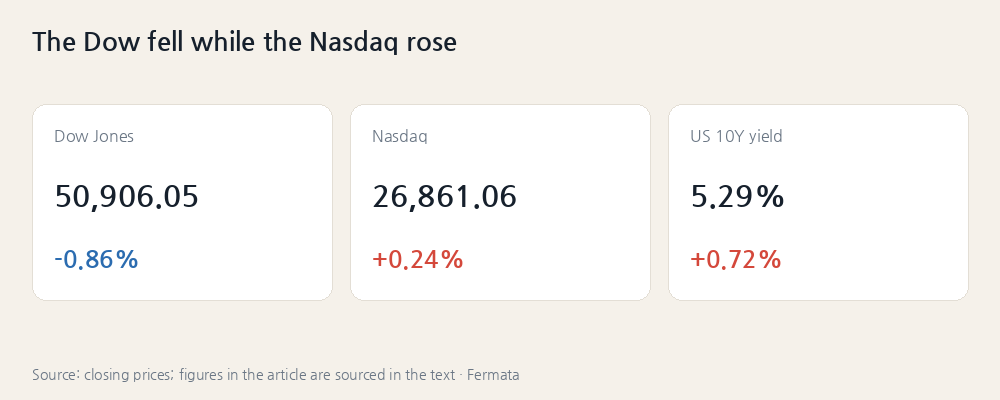
US stocks split down the middle on September 30. The Dow fell 0.86% to 50,906.05, while the Nasdaq Composite gained 0.24% to close at 26,861.06. The S&P 500 slipped 0.25% to 7,651.54 and the Russell 2000 lost 0.39% to 2,796.86.
The bond market moved more than stocks did. The 10-year Treasury yield rose 0.72% to 5.29% and the 30-year rose 0.79% to 5.64%, each a fresh high since 2002. The VIX climbed 1.87% to 16.34, its second straight daily gain.
Yesterday's check-in: how it played out
Yesterday’s piece left three things to confirm by September 30: whether Micron would clear consensus (revenue $50.8B, EPS $31.50), whether August’s PCE reading would strengthen the case for another rate hike, and whether Treasury yields would test their 2002-era highs again.
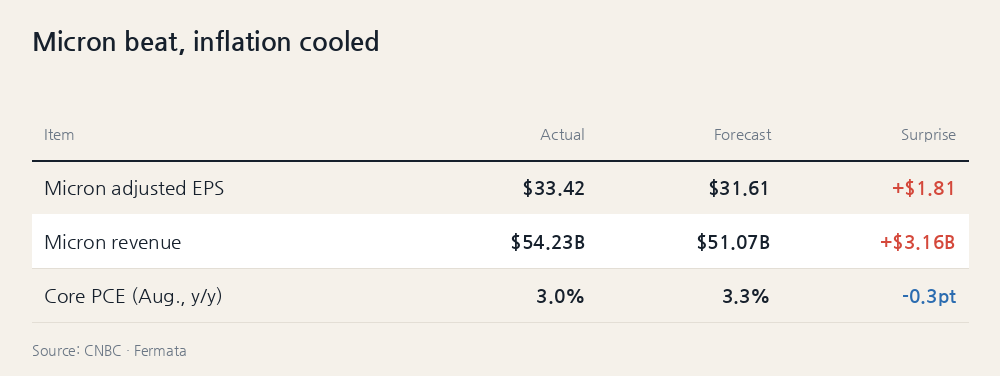
The results were mixed. Micron’s fiscal fourth-quarter report, released after the close, beat on both lines — adjusted EPS of $33.42 (vs. $31.61 expected) on revenue of $54.23 billion (vs. $51.07 billion expected). Core PCE inflation came in cooler than expected, easing rather than strengthening the case for another hike. Yet the 10-year yield still hit a fresh high of 5.29%. Two out of three went as expected; one went the opposite way.
Treasury yields, a fresh 24-year high again
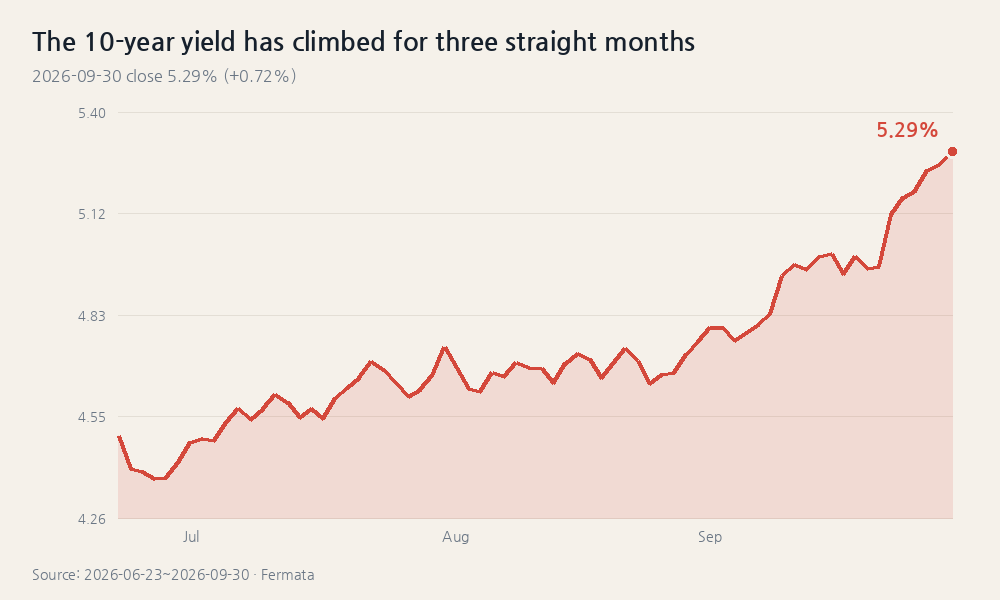
Treasury yields told a clearer story than stocks did. The 10-year rose 0.72% to 5.29% and the 30-year rose 0.79% to 5.64%, both fresh highs since 2002. The 10-year was at 5.26% yesterday — today’s move set a new record within a single session.
No single reason explains the climb. Heavy Treasury issuance, the possibility of another Fed hike, and signs the economy is still holding up are all in the mix. That yields rose even after a softer-than-expected inflation reading suggests the move isn’t about inflation alone.
Inflation cooled, but yields didn't follow
August’s Personal Consumption Expenditures (PCE) price index rose 3.4% year over year, below the 3.7% forecast. Core PCE, which strips out volatile food and energy prices, rose 3.0% versus a 3.3% forecast, and was up just 0.2% month over month versus a 0.3% forecast — a step down from July’s 3.3%.
For beginners: the PCE price index is the inflation gauge the Federal Reserve watches most closely when setting policy. ‘Core PCE’ strips out food and energy to filter out short-term swings in gas and grocery prices and show the underlying trend.
New York Fed President John Williams had already sounded cautious about an October hike. Today’s cooler inflation reading makes that hike look less likely still, but Treasury yields didn’t follow that signal — a sign that heavy bond supply and fiscal concerns are weighing on yields more than any single inflation report.
Today's biggest drop: Moderna
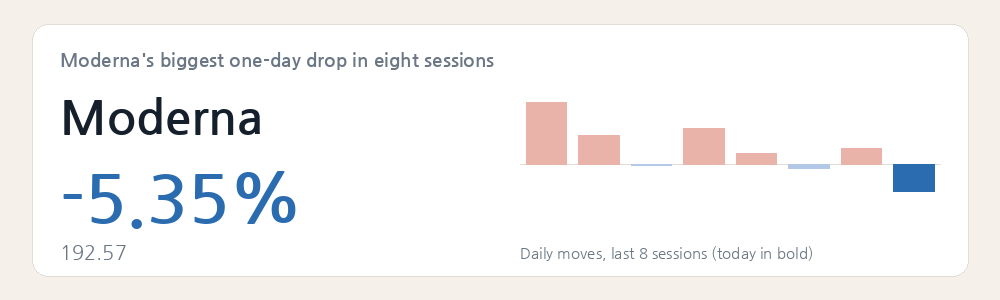
The biggest mover among the stocks we follow today was Moderna (-5.35%). The stock fell from $203.46 to $192.57 in a single session.
Citigroup cut its rating from Neutral to Sell — while raising its price target from $60 to $80. Raising the target while cutting the rating sounds odd, but Citi’s logic is simple: the stock has run up far faster than the target itself. Moderna is up more than 590% this year, largely on the back of late-stage melanoma-recurrence data it announced with Merck in August.
Intel moved the other way
Moving opposite Moderna was Intel (+3.71%), which climbed from $115.93 to $120.23.
According to Yahoo Finance, reports that Intel could raise CPU prices again in October helped push the stock higher. Coming amid a broader narrative of reviving data center and AI demand, the report read as a sign the company has pricing power to spare.

Oracle and Bloom Energy, still feeling the aftershocks
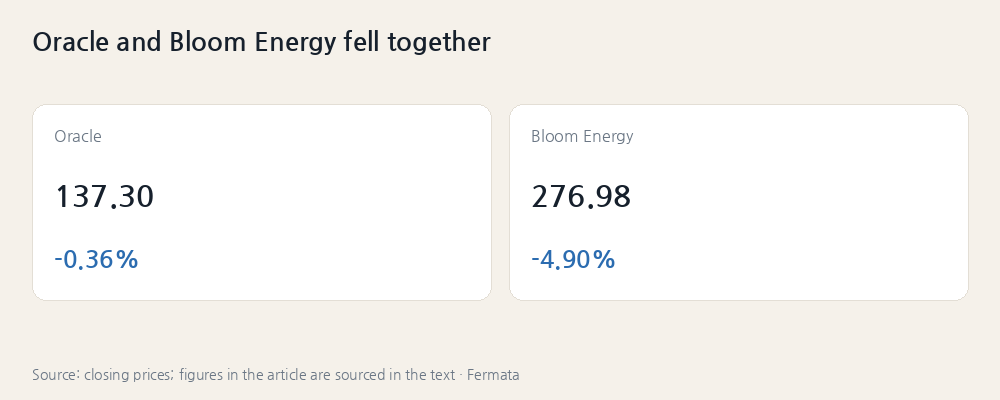
Oracle (-0.36%) and Bloom Energy (-4.90%) fell together again. Both have been swinging on news tied to Oracle’s ‘Project Jupiter’ data center.
The project was meant to run on Bloom Energy fuel cells, but completion of the natural-gas pipeline it needs slipped nearly five months behind schedule. Bloom Energy had bounced once on that news after Jefferies kept its $335 price target, arguing the stock looked undervalued, but it fell 4.90% today to $276.98 — a sign the underlying pipeline delay still hasn’t been resolved.
Today's volume leaders: chips and space
Familiar names topped today’s trading-value list again: Space Exploration Technologies (+1.09%, $11.9B traded), Sandisk (+0.59%, $10.3B), AMD (+0.69%, $10.0B), Broadcom (-1.10%, $6.8B), and Oracle (-0.36%, $6.3B).
Each landed on this list for its own reason. Oracle and Broadcom are riding the Project Jupiter aftershocks above; AMD and Sandisk reflect memory and AI-chip demand expectations ahead of Micron’s earnings. Space Exploration Technologies ties into the institutional flows we cover below.
Micron cleared consensus by a wide margin
Micron’s fiscal fourth-quarter results, released after the close, showed adjusted EPS of $33.42 (vs. $31.61 expected) on revenue of $54.23 billion (vs. $51.07 billion expected). Data center revenue jumped 11-fold from a year ago.
The guidance was even louder. Micron guided next quarter’s revenue to $61.5 billion (plus or minus $1.5 billion, versus a $56.77 billion consensus) and adjusted EPS to $38.15 (plus or minus $1, versus a $36.02 consensus). Gross margin is expected to reach roughly 86.25%, and management said fiscal 2027 should be a record year with revenue growing every single quarter.
This earnings print carries over to Korean chipmakers
High-bandwidth memory (HBM) is what’s driving Micron’s guidance. The company said it’s already shipping HBM4 in volume and developing HBM4E for 2027, and expects memory and storage supply to run tighter in fiscal 2027 and 2028 than it did in fiscal 2026.
The semiconductor index (SOXX) rose just 0.21% today, since the news broke after the close and isn’t priced in yet. Korean memory makers like SK Hynix share Micron’s customer base and cycle. How strong Micron’s guidance really was will show up first in how Korean chip stocks react in the next Korean trading session.
September closes out with a split scoreboard
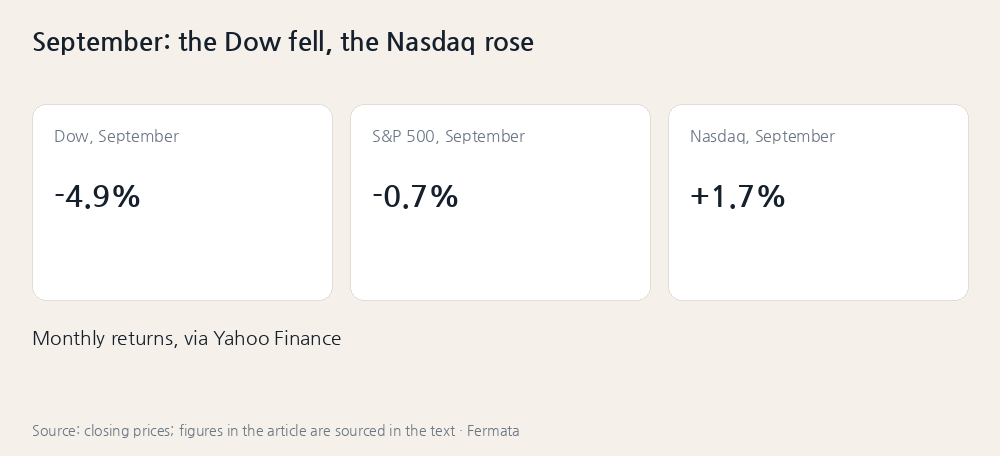
Today marked the last trading day of September. Over the full month, the Dow fell 4.9% and the S&P 500 fell 0.7%, while the Nasdaq Composite gained 1.7%. As Treasury yields climbed all month, only the tech-heavy Nasdaq held its ground.
October’s question is whether Micron’s earnings surprise extends that pattern, or whether Treasury yields eventually drag the broader market down with them.
What to watch next session
First, how the stock reacts to Micron’s earnings surprise in the next session. Second, whether that strength carries over to Korean chip stocks. Third, whether the Treasury yield keeps climbing past 5.29% or settles at this level.
What's worth knowing today
Micron's data center revenue jumped 11-fold in a year
The standout number in Micron’s fiscal fourth quarter was data center revenue. Per CNBC, that segment’s revenue jumped 11-fold from a year earlier, and overall gross margin already topped 86%. It’s the product of both rising high-bandwidth memory (HBM) prices and rising volumes.
Micron said it’s already shipping HBM4 in volume and developing HBM4E for 2027. Management expects memory and storage supply to run tighter in fiscal 2027 and 2028 than it did this year — meaning the supply-demand squeeze isn’t over yet.
Per Investing.com, next quarter’s guidance (revenue of $61.5B, adjusted EPS of $38.15) cleared consensus ($56.77B and $36.02, respectively) by a wide margin. Management said fiscal 2027 should be a record year with sequential revenue growth every quarter.
| Data center revenue growth | 11x year over year |
| Next-quarter revenue guide | $61.5B (vs. $56.77B consensus) |
| Next-quarter EPS guide | $38.15 (vs. $36.02 consensus) |
| Gross margin outlook | ~86.25% |
Coatue made big bets on Micron and SpaceX last quarter
13F filings disclose holdings as of June 30, 2026, with a 45-day lag — this is a second-quarter snapshot, not a current position. Still, the direction lines up with today’s trading-value leaders.
Coatue Management added 2,976,338 shares of Micron during the quarter, a 1,794% increase that amounts to an almost entirely new position. The same quarter, it opened a new stake of 18,561,780 shares in Space Exploration Technologies — the same stock topping today’s volume list — and added 3,904,033 shares of Amazon (+49%) and 342,979 shares of Broadcom (+6%).
Berkshire Hathaway also sharply increased its Alphabet stake that quarter (Class A +45%, Class C +658%). Two large managers pivoting toward AI infrastructure, chips and space in the same quarter is worth noting.
| Coatue – Micron | +2,976,338 shares (+1,794%) |
| Coatue – SpaceX | New stake of 18,561,780 shares |
| Coatue – Amazon | +3,904,033 shares (+49%) |
| Berkshire – Alphabet Class C | +23,603,218 shares (+658%) |
Why Citi cut Moderna to Sell

Photo: National Cancer Institute / Unsplash
Moderna was up more than 590% this year before Citigroup’s downgrade. The rally traces back to late-stage melanoma-recurrence data the company announced with Merck in August.
Per CNBC, Citi analyst Geoff Meacham raised his price target from $60 to $80 while cutting his rating from Neutral to Sell — meaning the stock had run up far past the target itself. He argued Moderna’s roughly $80 billion market cap now rivals Regeneron’s despite materially smaller revenue and earnings, and that even assuming a 100% success probability for its lead oncology program only justifies a share price around $100 — roughly half where the stock traded before the downgrade.
Moderna closed down 5.35% at $192.57 today. The clinical data itself hasn’t changed — what’s in dispute is how much of it is already priced in.
| Citi price target | $60 -> $80 |
| Citi rating | Neutral -> Sell |
| YTD gain before downgrade | 590%+ |
Fermata’s Take
We’re not summing up today’s split results in one line. Micron cleared consensus on both earnings and guidance, with data center revenue up 11-fold. Inflation came in cooler than expected, yet the 10-year Treasury yield hit a fresh record of 5.29% anyway. Good news and a warning sign landed on the same day.
So while Treasury yields keep testing the high-5% range, we’re not adding to names whose valuations have already re-rated higher. We’re keeping names like Micron, which just proved its guidance with real results, on our watch list to see how that proof gets reflected in the stock. For a name like Moderna, up more than 590% this year on a single data readout, we’re checking — as Citi argued — whether valuation has outrun the fundamentals.
Next session, we’ll check how the stock reacts to Micron’s earnings surprise, whether that strength carries over to Korean chip stocks, and whether the Treasury yield climbs past 5.29%.
Check · 2026-10-01 — How the stock reacts to Micron's earnings surprise in the next session, whether that strength carries over to Korean chip stocks (SK Hynix and others), and whether the 10-year Treasury yield climbs past 5.29%.
Sources
- Yahoo Finance Stock market today: Dow, S&P 500 post monthly losses in September as Treasury yields climb
- CNBC Moderna has been on a tear since mid-August. Citi now sees it plunging 60%
- CNBC Fed's preferred gauge showed core inflation at 3.0% in August, much lighter than expected
- CNBC Micron beats on earnings and issues strong guidance as data center revenue jumps 11-fold
- Investing.com Micron forecasts stronger first quarter as AI demand accelerates
- Yahoo Finance Intel Could Be Set to Raise Prices, Again. The Stock Is Soaring
- Yahoo Finance Jefferies Just Raised Its Bloom Energy Price Target — Stock Jumps 10%