![U.S. Market Close data snapshot for 2026-09-10: Dow Jones Industrial Average 52,064.1 (-0.60%), S&P 500 7,591.7 (-0.58%), Nasdaq Composite 26,081.72 (-0.65%), biggest moves we track WTI Crude Oil (+8.25%), Intel (-5.57%), Oracle (-5.38%) [en].](https://fermata.it.kr/wp-content/uploads/2026/09/us_2026-09-10_editorial_en-d7c6def81068.png)
Wall Street Falls a Fourth Day as Bond Yields Jump on Hot PPI
Today's mood
Wall Street fell for a fourth straight session. Oil climbed back above $100 a barrel and wholesale inflation ran hotter than expected, pushing Treasury yields higher and weighing on risk assets across the board.
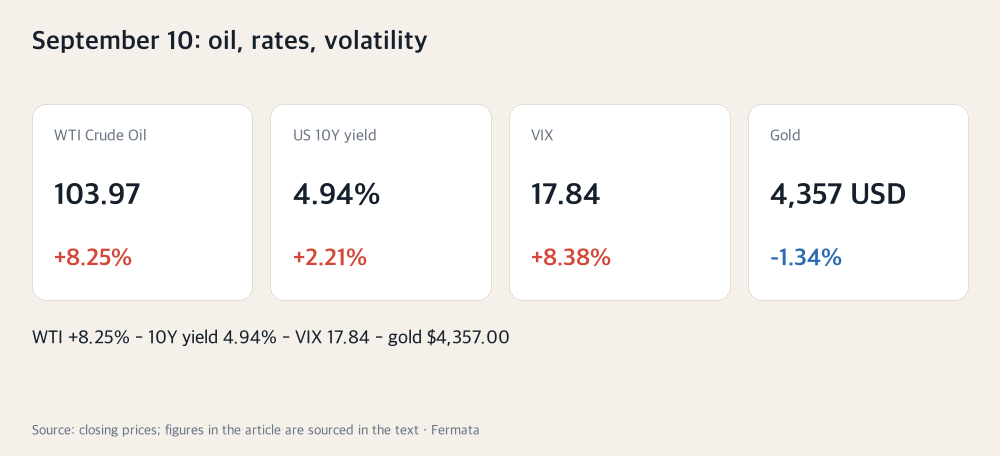
The Dow closed at 52,064.10 (-0.6%), the S&P 500 at 7,591.70 (-0.58%), and the Nasdaq Composite at 26,081.72 (-0.65%). The small-cap Russell 2000 led losses, down 1.04%, while the VIX jumped 8.38% to 17.84.
Not everything moved the same way. Apple rose 3.56% on a wave of price-target hikes after its product event, while most chip stocks bore the full weight of rising Treasury yields.
A fourth straight losing session
All three major indexes failed to post a single gain this week. Four consecutive down days is an unusual run for this year.
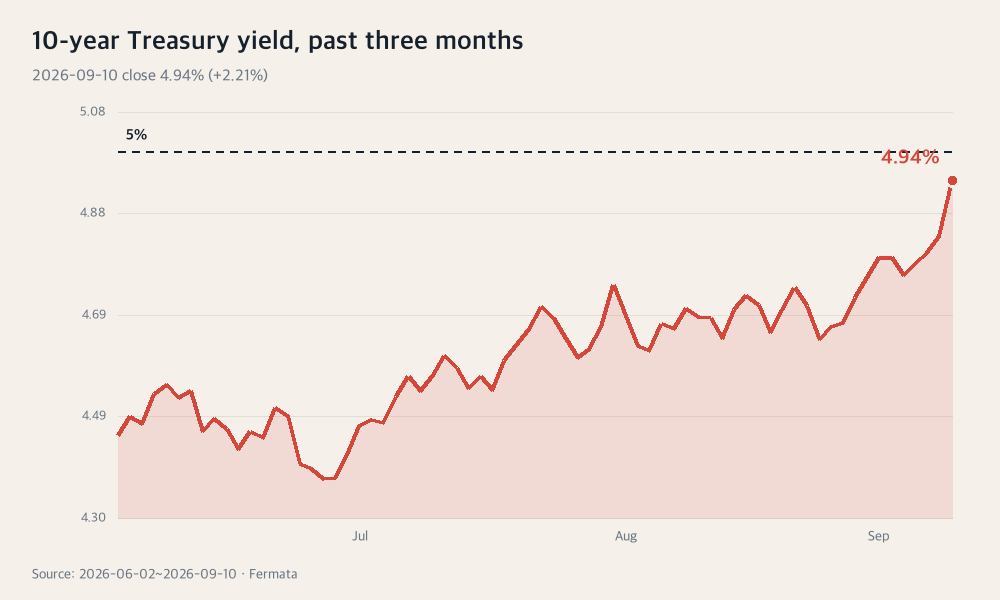
Treasury yields climbed steadily over the same stretch. The 10-year rose from 4.84% to 4.94%, and the 30-year from 5.29% to 5.36%. Gold, oddly, fell 1.34% to $4,357.00 an ounce — an unusual combination for a risk-off day.
Yesterday's checkpoint, graded
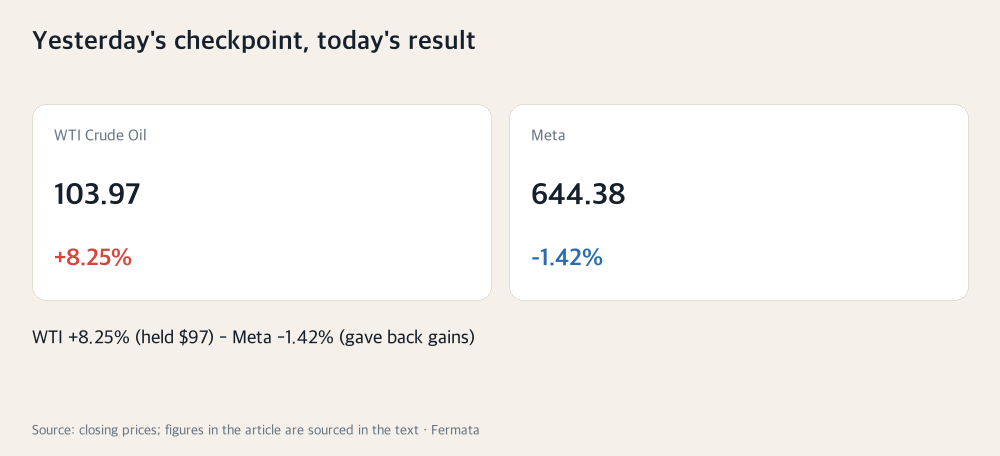
Yesterday we said we’d check whether Meta’s rally held and whether WTI Crude Oil stayed above $97 a barrel.
Half right. WTI Crude Oil jumped 8.25% to $103.97, comfortably above $97. Meta, though, fell 1.42% to $644.38, giving back the prior day’s gain.
Crude oil broke back above $100
WTI Crude Oil jumped 8.25% to settle at $103.97 a barrel. Brent crossed $100 intraday as well.
The US-Iran conflict is now in its seventh month. Attacks on tankers near the Strait of Hormuz have picked up again in the past few days, and shipping volume through the strait has reportedly dropped sharply. A jump in oil feeds into broader inflation through commodity costs, and bond markets priced that risk in today.

Producer prices reignited inflation worry
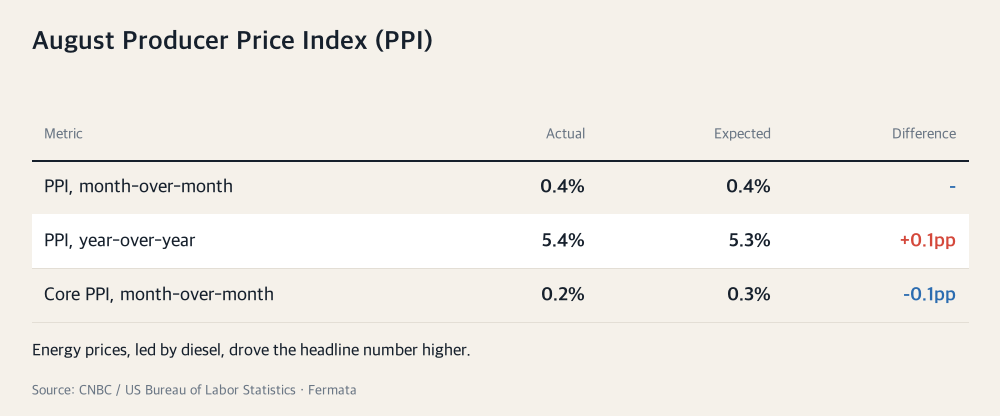
The Labor Department released August’s Producer Price Index today. It rose 0.4% month-over-month, matching expectations, but the annual rate came in at 5.4%, slightly above the 5.3% consensus. July’s reading was also revised up, from flat to 0.1%.
Underneath the headline, the picture was mixed. Core PPI, which excludes food and energy, rose just 0.2%, actually below the 0.3% forecast. Energy — diesel alone jumped 24.1% — did most of the lifting, the same force behind today’s oil spike.
Tomorrow’s CPI report will be the next test of whether that worry deepens or eases.
Why chip stocks fell together
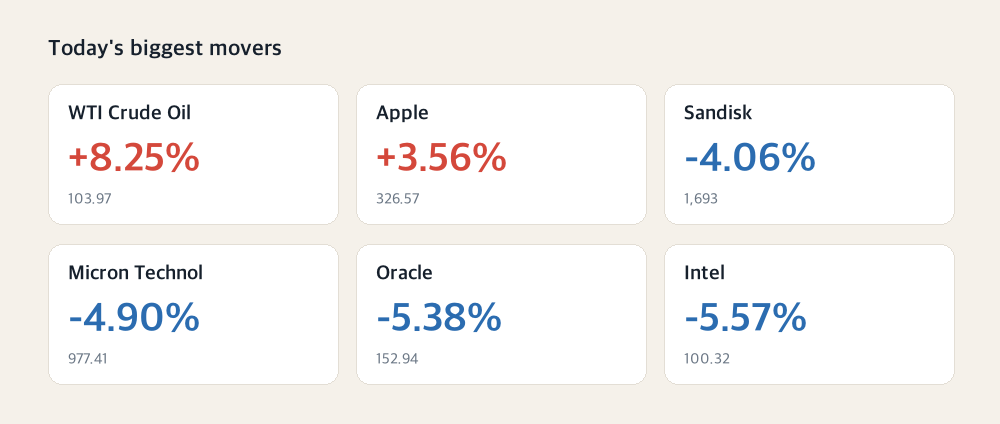
Semiconductors were the day’s weakest group. The Philadelphia Semiconductor Index (SOXX) fell 2.74%; Intel dropped 5.57%, Micron 4.90%, Nvidia 2.37%, AMD 3.36%, and Broadcom 0.97%.
That’s the order you’d expect when rates are the cause. Assets whose value depends more on profits far in the future are hit harder when Treasury yields rise.
For beginners: duration measures how long it takes to recoup an investment. Chipmakers and AI infrastructure companies, whose valuations lean heavily on future earnings, have long duration — so a rise in rates cuts more sharply into the present value of those distant profits.
Within the group, the reasons varied. SanDisk’s 4.06% drop looks more like a broad pullback from tech, while Intel had an extra catalyst: Piper Sandler initiated coverage today at Neutral with a $110 price target, arguing the stock, up more than fourfold over the past year, has less room left to run. The same firm started Nvidia at Overweight.

Two earnings due tonight
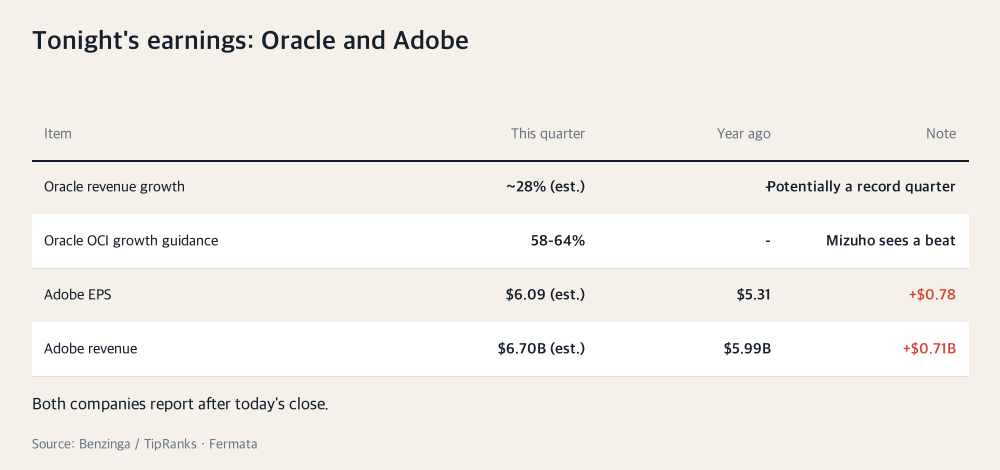
Oracle and Adobe both report after today’s close. Oracle fell 5.38% during the session, one of the sharpest moves among the stocks we follow.
Wall Street expects Oracle’s revenue to grow more than 28%, potentially its fastest quarterly growth on record. Mizuho expects its cloud infrastructure (OCI) business to beat estimates. But Oracle has taken on heavy debt to fund AI infrastructure, and S&P Global cut its credit rating in July; free cash flow is projected to stay negative through 2029.
Adobe reports its fiscal third quarter the same night. Consensus calls for EPS of $6.09 and revenue of $6.70 billion, up from $5.31 and $5.99 billion a year ago. Barclays, Citigroup and Jefferies recently held or nudged up their targets to $295, $301 and $285 — a broadly ‘hold’ view.
Both reports land tonight US time; we’ll cover the reaction in tomorrow’s brief.
Apple moved the other way
Apple closed up 3.56% at $326.57, a standout on a day when most stocks fell. Analysts raised price targets in a wave after yesterday’s product event.
Wedbush lifted its target to $400 from $350, Bank of America to $380, and Melius Research to $385. The new Apple Watch lineup and AI features were the main argument for a stronger iPhone upgrade cycle ahead.
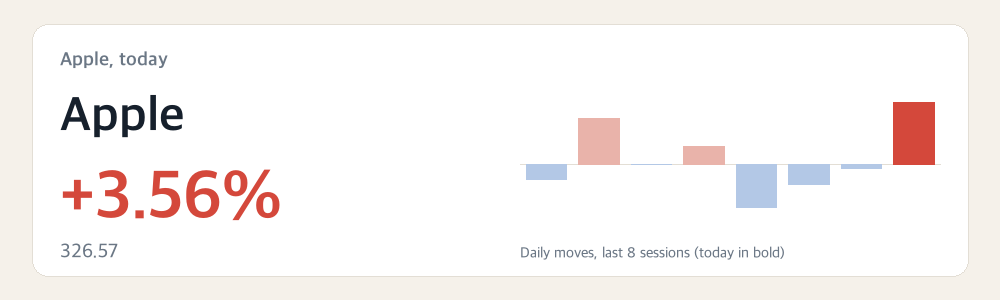

Photo: Sergi Kabrera / Unsplash
What carries into the Korean market
Today’s chip selloff is a test for tomorrow’s Korean session too. Micron’s 4.90% drop and Intel’s 5.57% drop look more like a rates story than a memory-industry problem, but they could still weigh on sentiment toward SK Hynix and Samsung Electronics.
The underlying industry story is different, though. Recent reports say Samsung and SK Hynix’s DRAM inventories have fallen below ten days’ worth, and that the shortage could persist into 2027. If today’s US memory-stock decline is a rate story, it runs on a separate track from that supply story.
Why bond yields climbed again
The 10-year Treasury yield rose to 4.94% today, its highest level in the past 90 days. The 30-year climbed alongside it, to 5.36%.
When inflation data runs hotter than expected, bond markets read it as the Fed holding rates higher for longer. The Fed’s blackout period, which began September 5 and runs through the September 17 meeting, means officials aren’t speaking publicly to calm nerves — part of why today’s moves were so sharp.
What we'll check next session
First, Oracle and Adobe. How the two stocks react after tonight’s earnings could set the tone for chip and AI-infrastructure sentiment broadly.
Second, tomorrow’s August CPI. We’ll watch whether headline and core diverge again the way PPI did today, and whether the 10-year yield pushes closer to 5%.
Third, oil. Whether WTI holds above $100 for several more days, and whether more Strait of Hormuz news emerges, will shape risk appetite into next week.
We’ll also watch whether memory-related names in the Korean market move in the same direction as today’s US session.
What we learned today
Buffett kept buying Alphabet through June
13F filings are a snapshot of the prior quarter, released 45 days after the fact. Still, they show which way the big money was leaning.
Berkshire Hathaway raised its Alphabet Class A stake by 24,541,369 shares (+45%) and its Class C stake by 23,603,218 shares (+658%) as of June 30. Pershing Square (Bill Ackman) started a new position in Microsoft over the same period, buying 5,654,078 shares.
Alphabet (GOOGL) happened to rise 0.59% today, one of the few gainers on a day when most chip stocks fell. June’s conviction doesn’t guarantee today’s direction, but the overlap is worth noting.
| Berkshire, Alphabet Class A change | +24,541,369 sh (+45%) |
| Berkshire, Alphabet Class C change | +23,603,218 sh (+658%) |
| Pershing Square, new Microsoft position | +5,654,078 sh (new) |
| As of | 2026-06-30 (13F) |
| Alphabet (GOOGL) today | +0.59% |
Intel looks expensive — so why the optimism?
Piper Sandler initiated coverage of Intel today at Neutral with a $110 price target. With the stock up more than fourfold over the past year, the firm sees limited room for further gains.
Intel’s forward P/E of 49.1x is far above Micron’s 6.3x or Nvidia’s 14.0x, both of which fell alongside it today. Yet Piper Sandler wasn’t entirely bearish: it argues that growing AI-agent usage should drive server CPU demand, and that tight CPU supply paired with strong demand could support high-teens revenue growth through 2030.
Valuation and growth narrative collided in the same stock on the same day.
| Intel forward P/E | 49.1x |
| Piper Sandler price target | $110 (new, Neutral) |
| Intel (INTC) today | -5.57% |
| For reference: Micron forward P/E | 6.3x |
Fermata’s Take
We read today’s decline as rate-driven risk aversion rather than a company-specific story. Intel, Micron, Nvidia, AMD, Broadcom and SanDisk all falling together is the evidence — isolated company problems don’t move together like that.
Look closer at today’s inflation data, though, and it wasn’t as bad as the headline suggested. Core PPI actually came in below forecast, and energy prices, led by diesel, did the heavy lifting on the headline number. We think markets are reacting more to the psychological weight of $100 oil than to underlying price pressure.
Next session, we’ll check how Oracle and Adobe shares move after earnings, and whether tomorrow’s August CPI comes in above consensus, both by the actual print and by percentage change.
Check · 2026-09-11 — Whether Oracle and Adobe shares moved after their earnings reports, and whether August CPI came in above consensus, both measured by the reported figures and percentage change.
Sources
- CNBC Wholesale prices rose 0.4% in August, as expected
- TheStreet Stock Market Today (Sept. 10, 2026): S&P 500, Nasdaq decline as Brent oil hits highest point since July
- Yahoo Finance Stock Market Today (Sept. 10, 2026): Dow futures edge higher ahead of inflation reports
- Al Jazeera US-Iran engaged in tanker war: Where is the months-long conflict headed?
- Yahoo Finance Intel Stock Plunges 4% as Piper Sandler Turns Neutral on Chipmaker
- Bloomberg Oracle Earnings to Test Market's Tolerance for AI Spending Risk
- Benzinga Top Wall Street Forecasters Revamp Adobe Expectations Ahead Of Q3 Earnings
- Benzinga What's Going On With Sandisk Stock Thursday?
- 24/7 Wall St. Prediction: Apple Stock Could Be Headed for a Big Move After Yesterday's Event
- Tom's Hardware Samsung and SK hynix warn AI-driven memory shortages could last until 2027 and beyond