![Korea Market Close data snapshot for 2026-09-10: KOSPI 7,033.92 (-0.25%), KOSDAQ 836.92 (+0.79%), USD/KRW 1,342.5 (+0.11%), biggest moves we track Jusung Engineering (+7.02%) [en].](https://fermata.it.kr/wp-content/uploads/2026/09/kr_2026-09-10_editorial_en-a7937e99945a.png)
Quadruple Witching Day: Why KOSPI Held Near 6,900
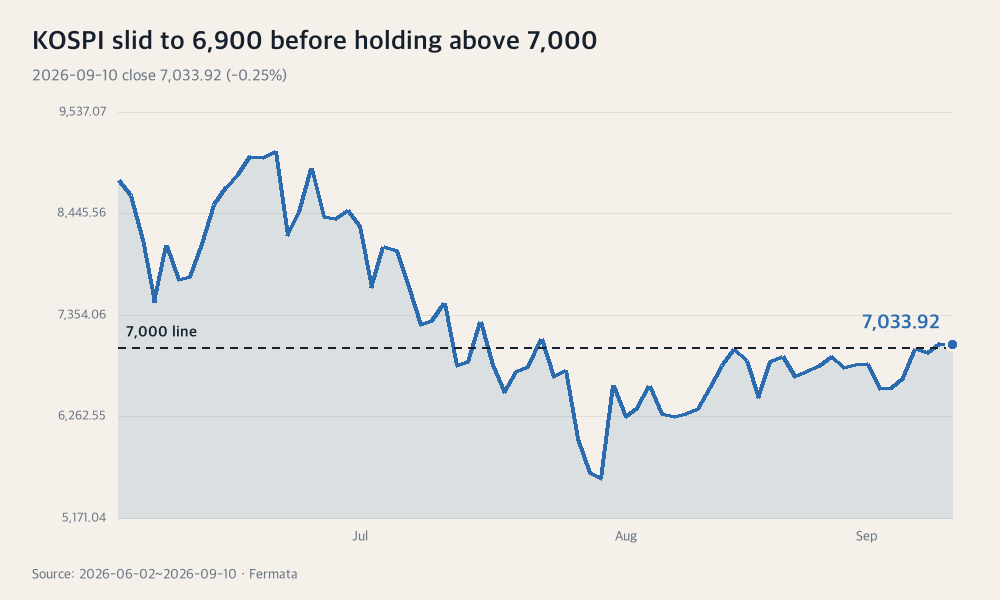
KOSPI slid to 6,900 before holding above 7,000
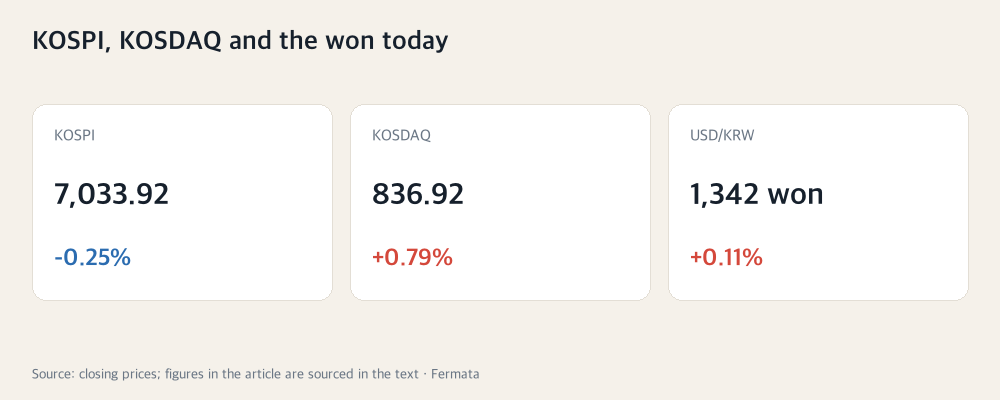
The KOSPI fell 17.72 points, or 0.25%, to close at 7,033.92. The KOSDAQ moved the other way, gaining 6.55 points, or 0.79%, to finish at 836.92.
According to the Korea Economic Daily, today was a quadruple witching day — the quarterly expiration of stock index and single-stock futures and options. The KOSPI opened at 7,038.85, slid as low as 6,898.45 in the morning (Segye Ilbo), then clawed back most of that decline as individual investors bought in. The index swung more than 140 points intraday.
What yesterday's check-in items looked like today
Yesterday’s brief flagged two things to watch: whether foreign investors would return to net buying, and whether Taihan Fiberoptics and other fiber-optic names would stay among the most actively traded stocks.
Both missed. Foreign investors did not return to buying — they widened their net selling from 427.2 billion won yesterday to 2.547 trillion won today (Financial News). Taihan Fiberoptics and its fiber-optic peers dropped entirely off today’s most-actively-traded list; the Corning-Verizon story turned out to be a one-day move.
Oil above $100 and surging Treasury yields set today's backdrop
Money Today reported that crude oil closed above $100 a barrel for the first time in four months. Brent settled at $101.21, up 3.36%, its first close above $100 since July 23, while WTI finished at $96.05, up 3.25%.
U.S. Treasury yields jumped the same day. According to Financial News, the 10-year Treasury yield climbed as high as 4.85% intraday, its highest level since November 2023. Oil and yields rising together was the direct backdrop for the KOSPI’s slide to 6,900 early in the session.
Wall Street fell for a third straight session
The Dow Jones Industrial Average fell 0.77% to 52,380.66, the S&P 500 fell 0.48% to 7,636.36, and the Nasdaq fell 0.64% to 26,253.34, marking a third straight losing session for all three major U.S. indexes (Financial News).
The cause was the same combination that shook the KOSPI: oil and yields rising together. In plain terms: when Treasury yields rise, it becomes more expensive for companies to borrow, and newly issued bonds pay more than older ones, making stocks relatively less attractive by comparison. Rising oil on top of that adds cost pressure for companies as well.
Foreign investors sold, institutions and individuals bought
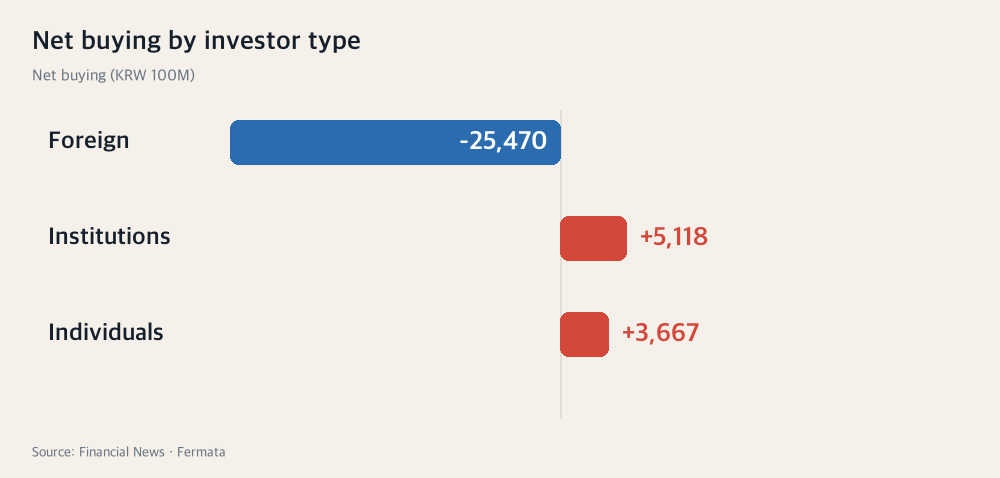
According to Financial News, foreign investors net sold 2.547 trillion won on the main board today. Institutions net bought 511.8 billion won, individuals net bought 366.7 billion won, and other corporate entities net bought 1.667 trillion won — together absorbing the foreign selling.
Foreign selling alone roughly matched the combined buying of the other three groups. That the KOSPI still fell just 0.25% is because individual buying picked up late in the session, reversing most of the intraday slide to 6,900.
Why KOSPI fell and KOSDAQ rose on the same day
The two indexes moved in opposite directions because large-cap chipmakers and chip equipment makers were running at different temperatures. Samsung Electronics (-0.19%) and SK Hynix (-0.16%) on the KOSPI edged lower, while chip equipment names on the KOSDAQ were strong.
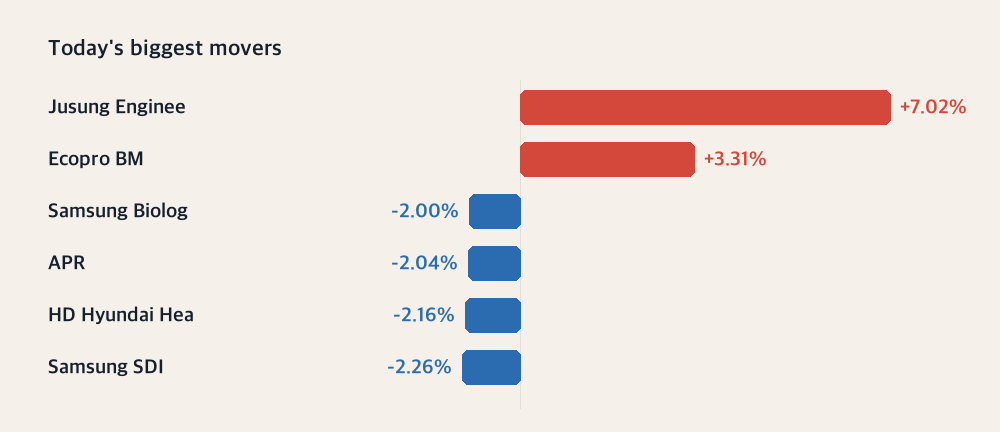
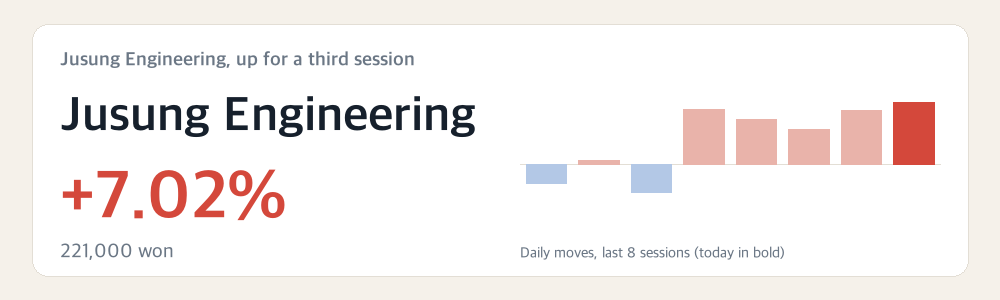
The Korea Economic Daily described today’s KOSDAQ gain as ‘small and mid-cap chip supplier strength driven by rebalancing demand.’ On quadruple witching days, the composition of KRX sector indexes is periodically revised, and index-tracking funds move in step with that revision. Among the stocks we follow, Jusung Engineering rose 7.02% to 221,000 won and led all names by trading value at 1.128 trillion won.
Today's protagonist: Jusung Engineering
Jusung Engineering rose for a third straight session, closing at 221,000 won. The Incheon Ilbo reported the company’s order backlog looks solid amid renewed chip-investment momentum, citing expectations for a purchase order from a Chinese chipmaker.
Today’s gain looks less like a single-day news event and more like a multi-day chip-equipment rally amplified by rebalancing flows. By trading value alone, its 1.128 trillion won was the largest among the stocks we follow today — a sign that money flowed more into KOSDAQ equipment names than into KOSPI large-caps.
Chip names where foreign investors sold and institutions bought
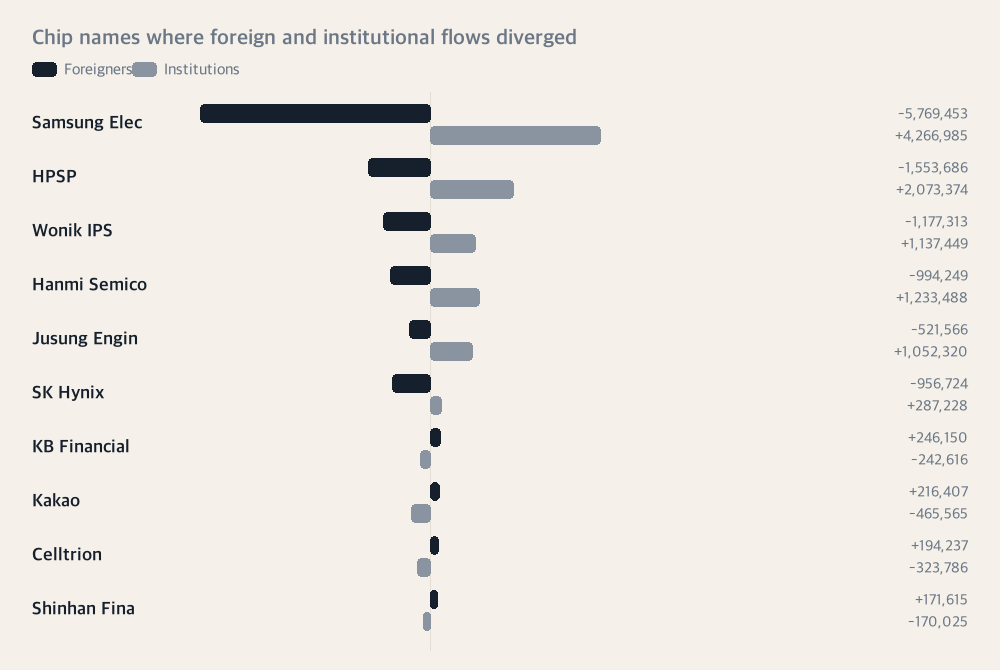
Today saw a clear pattern in semiconductors and chip equipment names: foreign investors selling while institutions bought. Samsung Electronics saw foreign investors net sell 5.77 million shares while institutions net bought 4.27 million. HPSP (foreign -1.55 million / institutions +2.07 million), Wonik IPS (foreign -1.18 million / institutions +1.14 million), Hanmi Semiconductor (foreign -0.99 million / institutions +1.23 million) and Jusung Engineering (foreign -0.52 million / institutions +1.05 million) showed the same shape.
The outcomes still diverged within the group — Samsung Electronics, HPSP and Wonik IPS edged lower while Hanmi Semiconductor (+1.00%) and Jusung Engineering (+7.02%) rose. What decided today’s direction was not how much institutional buying offset foreign selling, but whether other buyers piled on as well.
Insurers rose, airlines fell
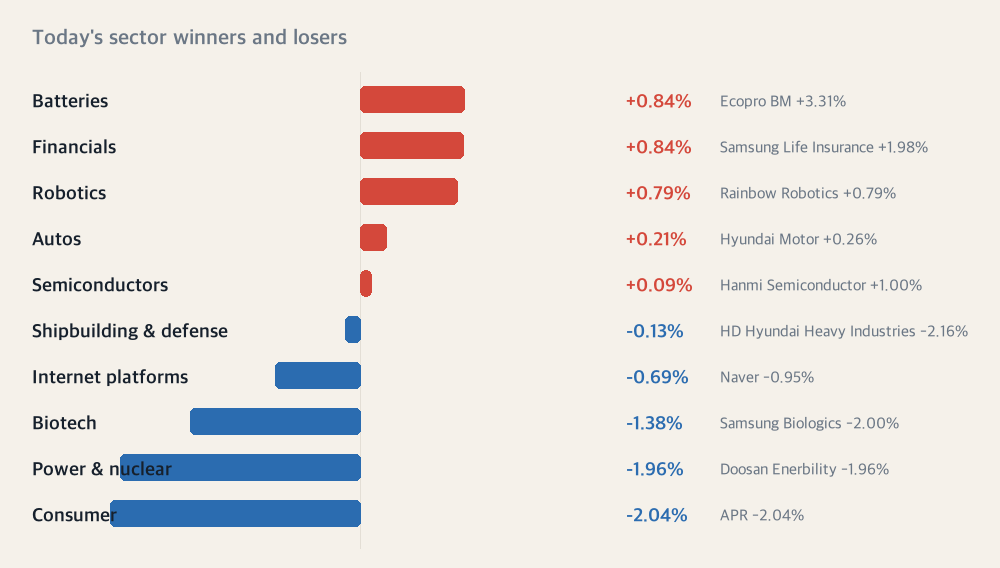
By sector, life insurance (+2.16%), gas utilities (+2.00%) and aerospace and defense (+1.47%) led gains, while health care technology (-2.63%), airlines (-2.28%) and electrical equipment (-2.20%) lagged.
NSP News linked today’s insurer strength to rising rates: when government bond yields rise, the valuation of insurers’ liabilities falls, improving their solvency ratios. Among the stocks we follow, Samsung Life Insurance closed up 1.98% at 309,500 won. The airline sector’s decline appears to reflect concern about rising jet-fuel costs now that oil has topped $100 a barrel, but we could not confirm a specific news item tied to today.
Why Korean bond yields jumped
According to the Bank of Korea’s ECOS data, the 2-year government bond yield rose 0.104 percentage points to 3.837%, and the 10-year yield rose 0.052 points to 4.453% — a large one-day move for either.
The trigger was the U.S. Treasury. Financial News reported the Treasury announced it would buy back up to $6 billion of 10-to-20-year bonds, three times its prior buyback size, but the market had expected more. That disappointment drove U.S. Treasury yields sharply higher — the St. Louis Fed’s FRED data shows the 10-year yield has climbed to 4.80% over the past 90 days, a new high for the period — and Korean government bond yields moved in the same direction.
The won
The won closed at 1,339.2 per dollar on Seoul’s spot market, up 3.1 won from the prior session (Money Today). Hana Bank’s 7:07 p.m. reference rate put the won at 1,342.5 per dollar, up 0.11% from the prior session.
Rising oil is typically a headwind for the won, but the fact that it firmed only modestly despite heavy foreign stock selling suggests other won-supportive forces were pushing back.
Today's Foreign Investor Flows
| Stock | Foreign net (shares) | Foreign ownership |
|---|---|---|
| SK Innovation | +333,369 | 15.85% |
| KB Financial Group | +246,150 | 79.15% |
| Kakao | +216,407 | 29.02% |
| Celltrion | +194,237 | 25.33% |
| Shinhan Financial Group | +171,615 | 61.89% |
| SK Hynix | -956,724 | 50.54% |
| Hanmi Semiconductor | -994,249 | 7.5% |
| Wonik IPS | -1,177,313 | 14.87% |
| HPSP | -1,553,686 | 33.03% |
| Samsung Electronics | -5,769,453 | 46.71% |
What to watch next session
First, U.S. inflation data: the producer price index lands on the 10th (U.S. time), followed by the consumer price index on the 11th. Either could determine whether today’s yield spike extends or cools.
Second, foreign investor flows. Whether today’s 2.547 trillion won in net selling was a one-day reaction or the start of a multi-day trend will become clearer if foreign investors return to net buying next session.
Third, whether the KOSDAQ chip-equipment rally has staying power. If Jusung Engineering and its peers stay among the most actively traded names next session, today’s rebalancing flow was not a one-day event.
Fourth, oil. Whether Brent holds above $100 will keep influencing the KOSPI’s next moves.
What stood out today
A disappointing buyback, not a rate decision, moved Treasury yields
The trigger behind today’s global Treasury yield spike was not a rate announcement but a U.S. Treasury buyback plan. According to Financial News, the Treasury said it would buy back up to $6 billion of bonds in the 10-to-20-year maturity bucket — three times its previous buyback size.
On its face, a larger bond buyback should push bond prices up and yields down. Instead, markets were disappointed: Financial News reported the market had expected an even larger purchase amount — tripling the size still fell short.
That disappointment pushed the 10-year Treasury yield as high as 4.85% intraday, its highest level since November 2023. Combined with oil crossing $100 and the resulting risk-off mood, the same combination fed directly into Korea’s own bond-yield spike (the 2-year rose 0.104 points) and the KOSPI’s intraday plunge.
| Treasury buyback size (10-20yr) | Up to $6B (3x prior size) |
| U.S. 10-year yield (intraday) | 4.85% (highest since Nov. 2023) |
| Korea 2-year bond yield | 3.837% (+0.104pt) |
On quadruple witching day, money flowed into KOSDAQ chip equipment names
On quadruple witching days, when stock index and single-stock futures and options expire together, the composition of KRX sector indexes is periodically revised. Because index-tracking funds move in step with that revision, flows can concentrate in certain stocks regardless of their individual earnings or news.
The Korea Economic Daily reported that today’s rebalancing demand concentrated in KOSDAQ chip equipment names. Beyond Jusung Engineering’s 7.02% gain, the paper reported TSE — a stock we do not follow — jumped more than 10%. The same article reported Hanmi Semiconductor, Wonik IPS, TES and DB HiTek, among other chip equipment and materials names, also rose more than 5% together; those figures are as reported by that article, not prices we verified ourselves.
On the same day, KOSPI large-cap chipmakers Samsung Electronics and SK Hynix both edged lower. That suggests rebalancing flows may have moved index weightings for equipment names more than for large-caps, but we could not find separate reporting confirming that causal link.
| Jusung Engineering | +7.02% (1.128T won traded) |
| TSE (as reported by Korea Economic Daily) | Up more than 10% |
| Samsung Electronics / SK Hynix | -0.19% / -0.16% |
Fermata’s Take
We see today’s 0.25% KOSPI decline as a relatively strong showing. Oil topping $100, U.S. Treasury yields spiking and a quadruple witching day all hit at once, yet the index clawed back more than half of its intraday slide to 6,900. That institutions, individuals and other corporate entities absorbed 2.547 trillion won of foreign selling supports that read.
We would not read this resilience as a sign that chip fundamentals are improving, though. What rose today was not KOSPI large-cap chipmakers but KOSDAQ equipment names, and much of that gain is explained by a one-day rebalancing flow tied to quadruple witching. Samsung Electronics and SK Hynix both edged lower today.
Next session, we will check whether foreign selling eases, and whether Jusung Engineering and other KOSDAQ chip-equipment names stay among the most actively traded stocks once the rebalancing flow has passed, alongside the KOSPI’s move.
Check · 2026-09-11 — Whether foreign net selling eases next session, and whether Jusung Engineering and other KOSDAQ chip-equipment names stay among the most actively traded stocks, checked alongside the KOSPI's move.
Sources
- Korea Economic Daily Korean-language article
- Money Today Korean-language article
- Segye Ilbo Korean-language article
- Financial News Korean-language article
- Korea Economic Daily Korean-language article
- Financial News Korean-language article
- Financial News Korean-language article
- Financial News Korean-language article
- Money Today Korean-language article
- Money Today Korean-language article
- NSP News Korean-language article
- incheonilbo.com Korean-language article