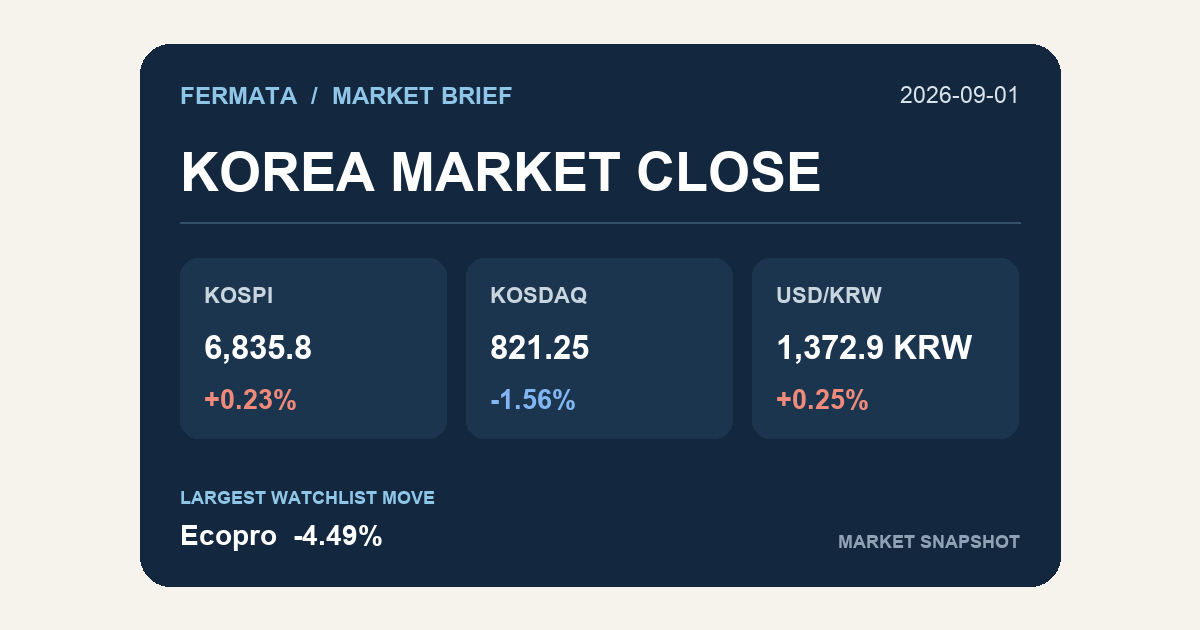
Buybacks Lifted KOSPI 0.23% While KOSDAQ Fell 1.56%
Today's Foreign Investor Flows
| Stock | Foreign net (shares) | Foreign ownership |
|---|---|---|
| Kakao | +102,298 | 29.07% |
| Ecopro | +89,595 | 19.38% |
| Ecopro BM | +11,204 | 14.82% |
| LG Energy Solution | +8,692 | 5.49% |
| Samsung Biologics | +4,960 | 13.1% |
| Rainbow Robotics | +2,688 | 5.48% |
| Naver | -729 | 35.93% |
| Samsung Electronics | -2,293 | 46.72% |
| Alteogen | -118,301 | 15.44% |
| SK Hynix | -211,935 | 50.56% |
The index rose. Almost everyone else was selling.
On September 1 the KOSPI closed at 6,835.80, up 15.78 points or 0.23%. The KOSDAQ, Korea's secondary board for smaller and growth companies, fell 13.04 points to 821.25, a decline of 1.56%. The won weakened 0.23% against the dollar to 1,372.70.
The index number hides what actually happened. According to Asiae's session tally, retail investors, foreign investors and domestic institutions were all net sellers of KOSPI shares. Exactly one category was buying: "other corporations," to the tune of ₩1.69 trillion.
Of the ten stocks on our Korea watchlist, three rose and seven fell. The index and the individual stocks moved in opposite directions.
That ₩1.69 trillion is corporate buybacks
In Korean market data, "other corporations" is the bucket for non-financial companies trading in the market — which is where a company buying its own shares shows up. Yonhap reported that share repurchases by Samsung Electronics and SK Hynix supported the index, turning an early decline into a modest gain by the close.
The stock-level numbers corroborate it. SK Hynix rose 1.14% to ₩1,693,000 even as foreign investors sold a net 211,935 shares. Samsung Electronics gained 0.38% to ₩261,000. Something was absorbing the selling.
This is now a pattern rather than an event. On August 31 the same buyback flow reversed an intraday drop of more than 3%. On September 1 it converted a lower open into a higher close. Two sessions running, the same buyer has been setting the floor.
KOSDAQ had no such buyer
Flows on the KOSDAQ ran the other way. Retail investors bought a net ₩434 billion, while foreign investors sold ₩152 billion and institutions sold ₩275 billion. With no large corporate bid underneath it, the index fell 1.56%.
Battery names led the decline. Ecopro dropped 4.49% to ₩87,200 and Ecopro BM fell 3.81% to ₩116,200; LG Energy Solution, listed on the KOSPI, lost 2.91% to ₩367,000. By sector, construction fell the most at 3.50%, followed by machinery and equipment at 1.34%.
What rose tells the same story from the other side: retail and distribution gained 2.98%, insurance 2.15% and financials 1.52%. Money left growth and moved toward defensives.
The won priced in Middle East risk
The won slipped 0.23% to 1,372.70 per dollar. Yonhap attributed the move to renewed Middle East tension combined with bargain-hunting dollar demand. Hankyung likewise described the KOSPI as closing modestly higher despite that tension.
For a foreign holder this matters directly. A weaker won reduces dollar-denominated returns on Korean equities regardless of what the share price does — which is consistent with foreign investors selling on both boards that day.
Semiconductors held, batteries did not
The split within a single session was clean. Large-cap semiconductors were supported by a flow factor — the buyback — while battery names fell with no comparable bid. The cards below show the actual closing move for a representative stock in each theme.
Foreign flows did not decide the day
The largest foreign net sale was SK Hynix, at 211,935 shares — and the stock rose 1.14%. Kakao saw net foreign buying of 102,298 shares and still slipped 0.14%. Alteogen was the case where flow and price agreed: foreign investors sold a net 118,301 shares and the stock fell 2.11%.
What to watch next session
First, whether corporate net buying continues. Buyback programs run to a disclosed size and schedule; they do not last indefinitely. The test is what the index does when that bid thins out. Second, the KOSPI–KOSDAQ gap. If only the large-cap index is being defended, an index gain does not mean the market recovered. A KOSDAQ that rises alongside it would say something different. Third, the won. Sustained Middle East risk that keeps the currency weak gives foreign investors a reason to keep selling.
Four currents behind today's numbers
The buyback bid is policy, not corporate generosity
The ₩1.69 trillion of corporate net buying that held the index up today did not appear out of nowhere. Korea's third round of Commercial Act amendments, now in force, makes cancelling repurchased shares mandatory rather than optional, and the Financial Services Commission has tightened the accompanying disclosure rules.
The scale is already large enough to move the market. Since corporate value-up disclosure began in May 2024, 590 companies had filed plans as of March 2026. Samsung Electronics alone approved a ₩7.2 trillion buyback on March 18 and a ₩5.3 trillion cancellation on March 31.
Cancellation is the part that matters. Retiring the shares reduces the count outstanding and lifts earnings per share. For an investor, though, the important caveat is that these programs run to a fixed size and schedule. A market held up by this bid is held up only as long as the program lasts.
| Corporate net buying today | ₩1.69tn |
| Samsung buyback approved (Mar 18) | ₩7.2tn |
| Samsung cancellation (Mar 31) | ₩5.3tn |
| Value-up filings by Mar 2026 | 590 companies |
Batteries are shifting from cars to grid storage
Ecopro fell 4.49%, Ecopro BM 3.81% and LG Energy Solution 2.91% today — the EV demand slowdown is still in these prices. But the industry's own outlook has moved on.
LG Energy Solution's US shipments of energy storage systems are expected to overtake its EV battery shipments from 2026, driven by power demand from AI data centre construction. That is a structural shift in where a battery maker's growth comes from: from vehicles to electricity infrastructure.
Ecopro shows a similar pivot. Ecopro Materials is forecast to turn profitable this year on revenue of ₩1 trillion and operating profit of ₩107.6 billion, with external precursor sales rising from 25% of output in 2025 to 70% in 2026 — from supplying affiliates to selling on the open market.
These are forecasts, not results. Today's decline is a reminder that the market has not yet priced them in.
| Ecopro Materials revenue (est.) | ₩1tn |
| Operating profit (est.) | ₩107.6bn — first profit |
| External precursor sales | 25% (2025) → 70% (2026) |
| LGES US ESS shipments | To overtake EV from 2026 |
Semis held up on more than flows

Photo: Maxence Pira / Unsplash
SK Hynix rose 1.14% despite foreign investors selling over 211,000 shares, and Samsung Electronics gained 0.38%. Buyback flow explains part of it. The demand backdrop explains the rest.
Real HBM demand in 2026 is forecast at 4.23 billion GB, a 95% increase year on year, against production of 4.44 billion GB. The global semiconductor market is expected to grow more than 25% to roughly $975 billion, with memory outpacing the average at around 30%.
As AI workloads move from training to inference, the shape of memory demand has changed with it. Both Korean makers have already committed much of their 2026 output, and SK Hynix is preparing the transition to HBM4.
Worth noting: at 4.23 billion GB of demand against 4.44 billion of supply, the two sit close together. If supply runs meaningfully ahead, pricing power changes.
How a 0.23% currency move reaches consumer prices

Photo: Jakub Pabis / Unsplash
The won weakened 0.23% to 1,372.70 today, which Yonhap linked to renewed Middle East tension. A single day's 0.23% is small; the transmission path is not.
Korea imports all of its crude. When oil rises and the won weakens, the import bill rises twice over. Domestic analysis puts the effect of Middle East-driven oil prices at an additional 1.2 percentage points on 2026 consumer inflation under a base case, and more than 1.6 points if high prices persist.
Higher inflation pushes rate-cut expectations further out. Rates staying high weigh on growth-stock valuations — which is consistent with today's sector split, where batteries and construction fell while insurance and financials rose.
For a foreign investor the currency carries a second meaning: a weaker won cuts dollar-denominated returns even when share prices rise. That is part of the backdrop to foreign investors selling on both boards today.
The session in one line
Behind a 0.23% gain sits a session in which retail, foreign and institutional investors all sold, and companies bought their own shares to absorb it.
That is why the index number is a poor summary of the day. A 1.56% decline on the KOSDAQ, and seven of ten watchlist stocks falling, is closer to how it actually felt.